Trade-Pro Food Distribution brings European dairy to Singapore, sourced from producers who share our standards, held at temperature and delivered six days a week.
More than a distributor, we're your growth partner.
Trade-Pro Food Distribution is a Singapore importer and distributor of premium dairy. We work with global producers who share our standards, so you can deliver the best to your customers.
Trade-Pro Food Distribution is the youngest company in Trade-Pro Group, which started trading in 2009. Dairy is the specialism, not a line on a catalogue.
Bonded warehouse services. Storage of imported dutiable food for export.
2010
Trade-Pro Shipping
Logistics and documentation for the growing export business.
2013
Trade-Pro Food
Import and export of frozen products, connecting ASEAN to global suppliers.
2016
Ship Supply
Frozen meats, seafood, dairy and processed foods to vessels worldwide.
2018
Food Distribution
Dairy across retail, foodservice and ecommerce in Singapore.
A message from the director
Dairy is unforgiving. A gap in temperature or a late truck and the product is worthless before it reaches the shelf. We built this business around closing those gaps: a facility designed for dairy, a fleet we own and route ourselves, and standards we get audited on every year.
That is what a principal is trusting us with when they hand us their brand in Singapore, and what a sub-distributor is buying when they take our stock. If you are weighing up either, talk to us directly.
Eugene TohDirector, Food Distribution
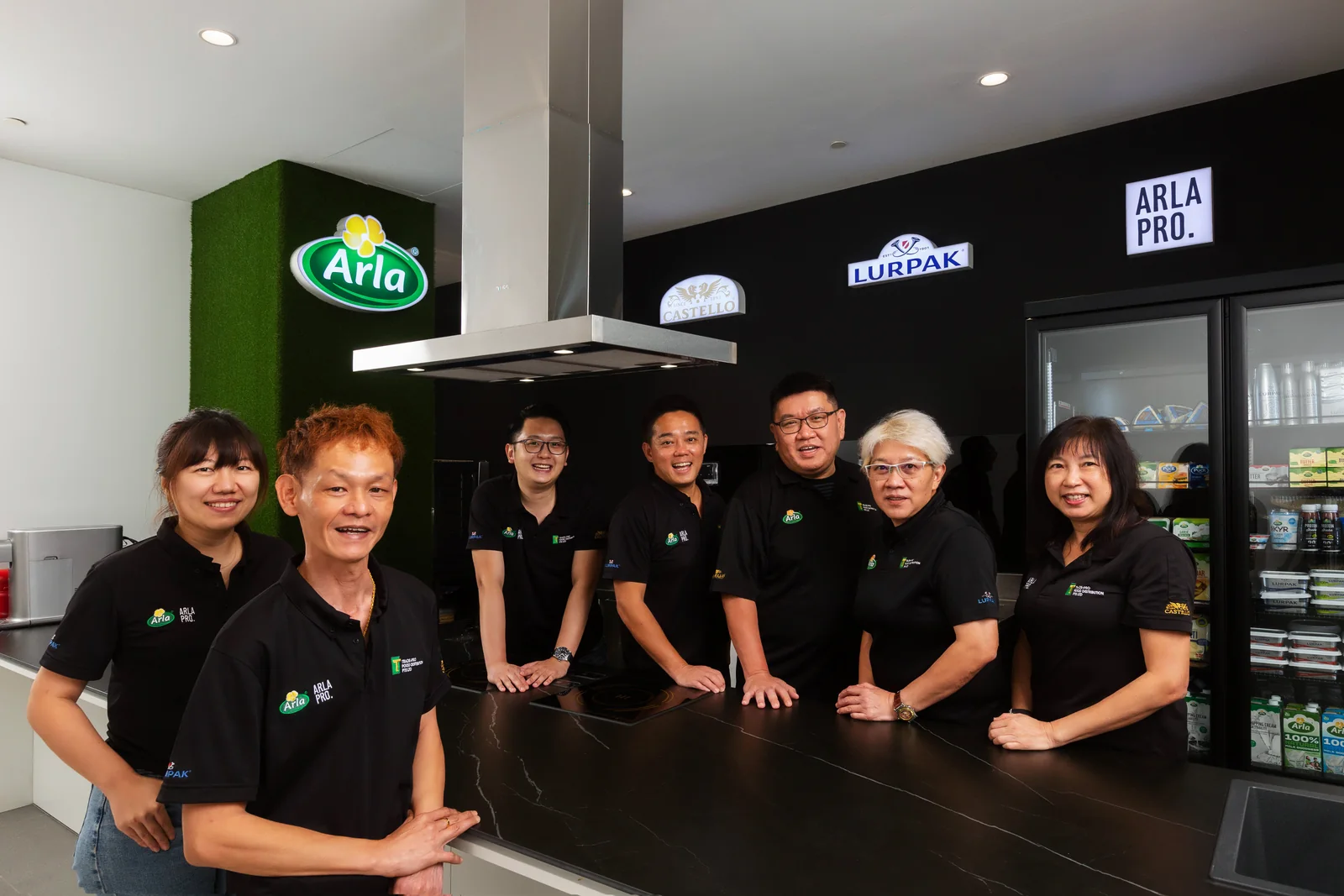
The team
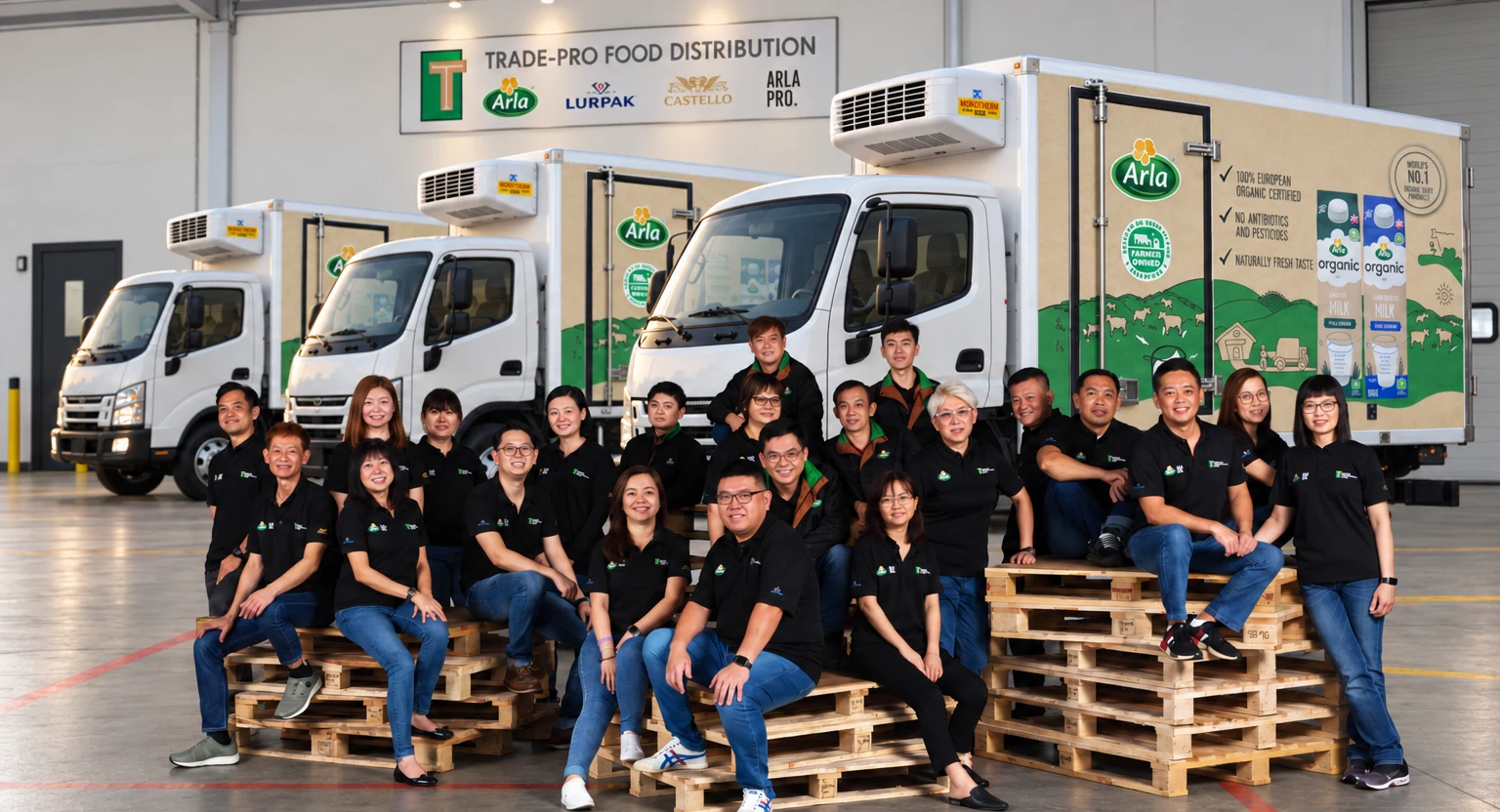
The people you'll work with.
Operations, retail, foodservice, ecommerce, quality and finance. Whichever conversation you are starting, one of them owns it end to end.
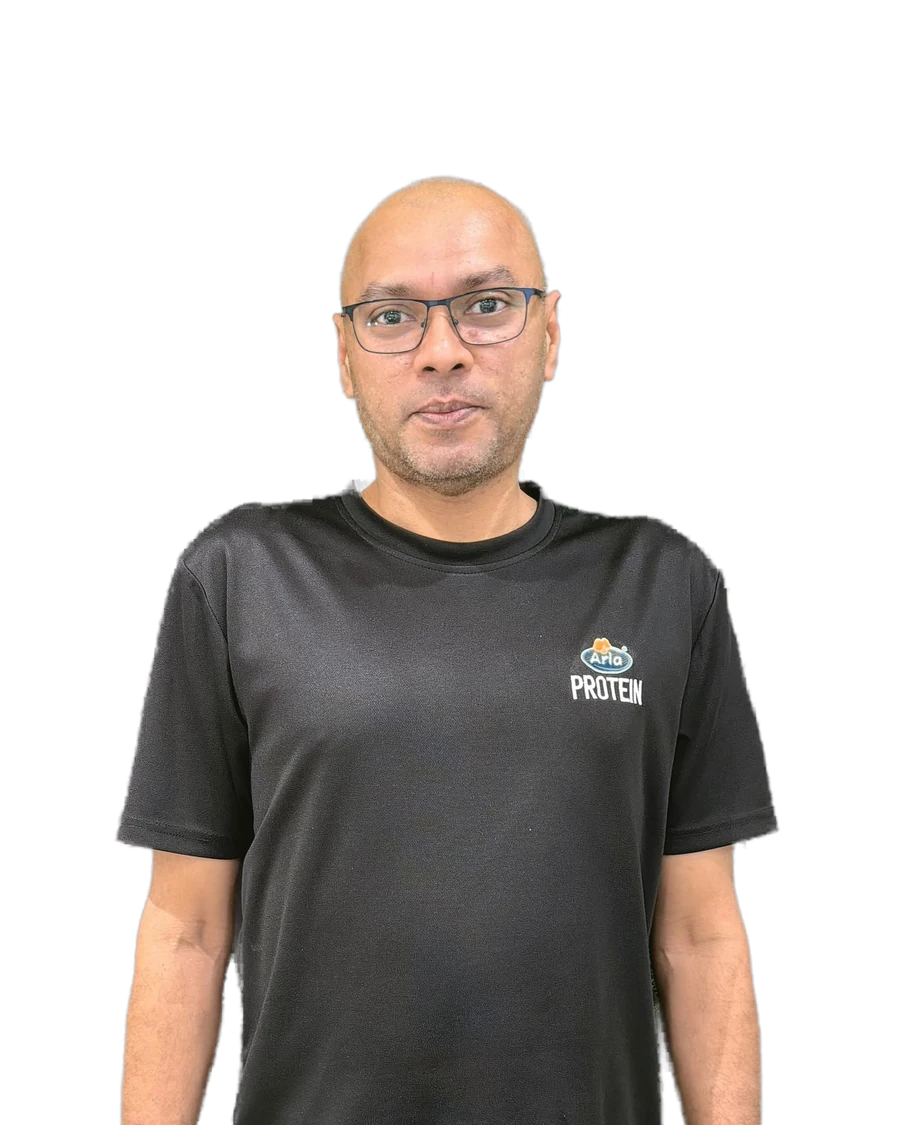
Thirty-one years in food, eleven of them in kitchens before he crossed to the commercial side. Roger runs the facility, the fleet and the six-day delivery week, and still judges a product by whether it would survive a real service.
Deputy General Manager, Procurement and Admin
Sharon Bay
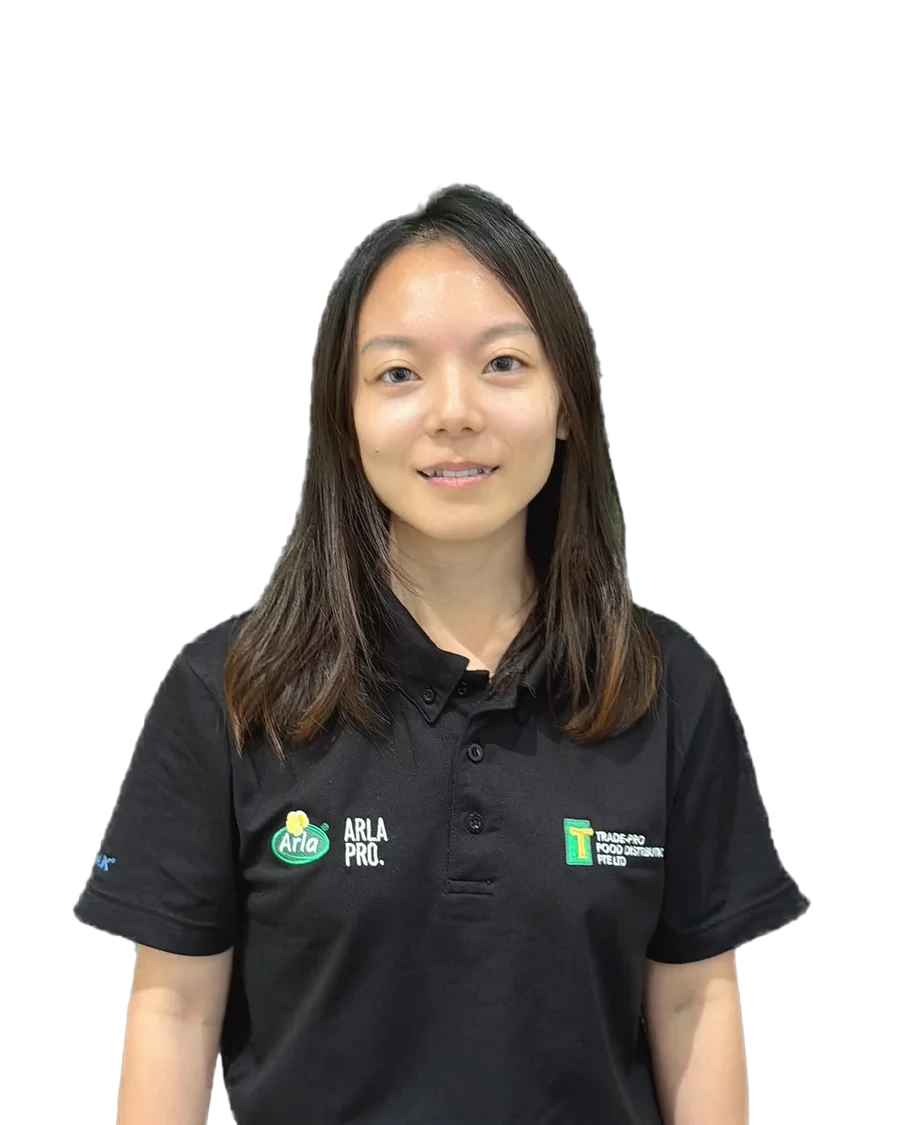
Sharon buys the range and negotiates the terms behind it, then runs the administration that keeps both honest. What we can quote on a line, and whether we can hold that price, starts at her desk.
Senior Manager, Head of Retail
James Lin
James owns the retail business: the buyers at the major chains, the range reviews, and what lands on shelf each week. He would rather walk a store than read a report about one, which is usually how a problem gets caught early.
Finance Manager
Wang Dan
Wang Dan handles credit terms, pricing structures and the paperwork behind every supply agreement. Opening an account goes across her desk, so she is often the first person here a new customer deals with properly.
Logistics Manager
Dave Ng
Dave turns a day of orders into runs that arrive cold and on time. Routes, loads, delivery windows, and the calls that come when a lift is down or a bay is full. The plan changes most mornings and he changes with it.
Sales Manager, Food Services
Lynn Sen
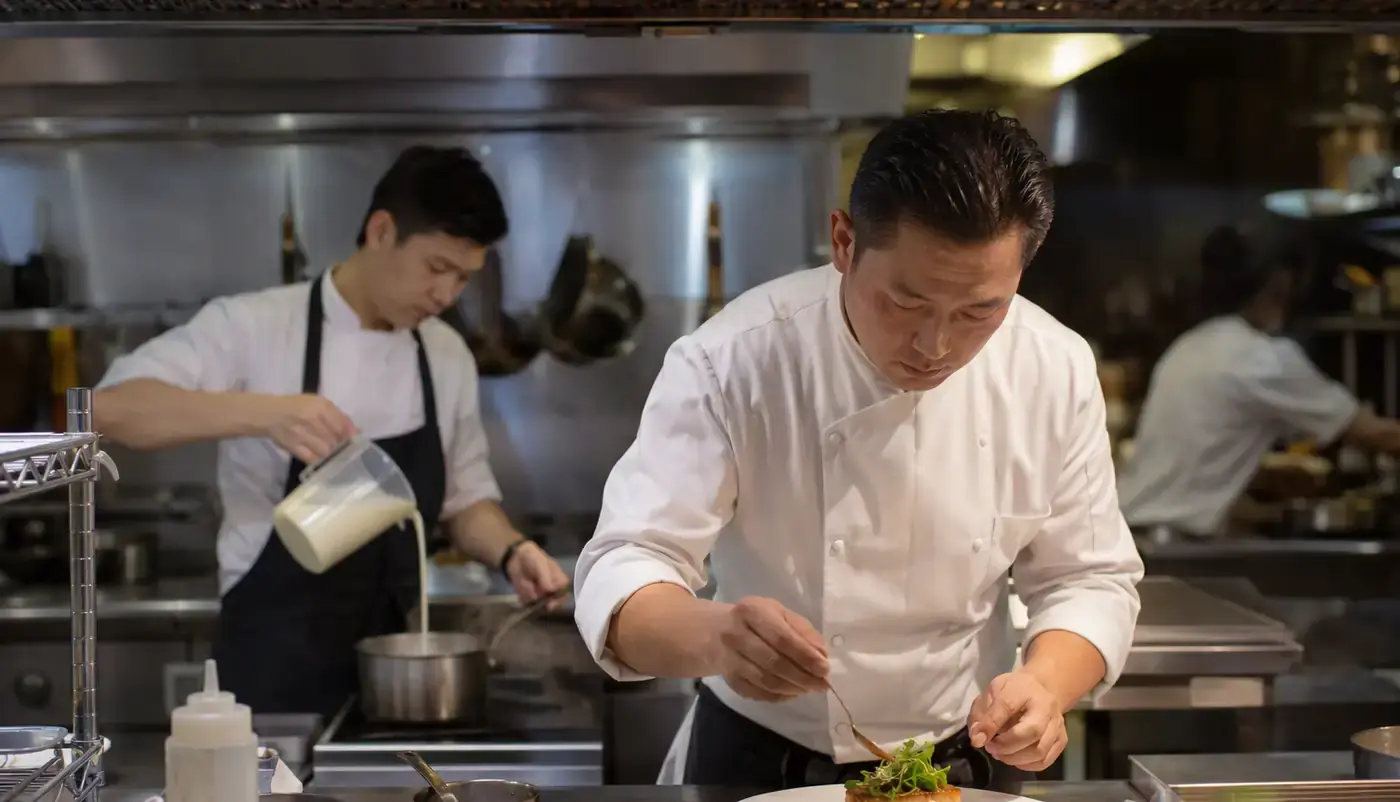
Lynn sells to hotels, restaurants and central kitchens, which means selling to people in the middle of service. She works out what a kitchen needs from a schedule before anything is promised, and will say no to an order she cannot see us keeping.
Key Account Manager, Food Services
Teo Chin Min
Teo holds the named foodservice accounts: the hotel groups, the chains and the central kitchens that order to a fixed pattern. Pricing, forecasts and the conversation that follows every menu change go through him.
Assistant Manager, E-Commerce & Marketing
Elise Koh
Elise runs the online grocery platforms we supply, along with most of what a customer sees before they speak to anyone. Listings, imagery, campaigns and the words that go with them.
Assistant Manager, Retail Operations
Sayed Bin Amir
Sayed keeps the retail accounts moving day to day. Orders in, stock where it should be, and the store-level problems that need solving before the next delivery rather than after it.
QA / QC, Food Services
Shiew Teng
Shiew Teng owns incoming inspection, temperature records and certification paperwork, and carries the ISO 22000 and FSSC 22000 audits each year. The work is invisible when it is done properly, which is most of the time.
Sustainability
Benchmarked annually through EcoVadis, rated Silver in November 2025, and a LowCarbonSG participant since 2024.
Environment
Emissions intensity down 1% a year against FY23
Energy and water minimised
Waste diverted from landfill
Safety
Zero days lost to injury
Zero recordable incidents
BizSafe Level 3 since 2022
People
100% health insurance coverage
Ten TAFEP standards
Annual ethics training
Supply chain
Supplier code of conduct by end 2026
Responsible animal husbandry
Deforestation-free sourcing
Certifications
Approved by industry experts.
FSSC 22000
ISO 22000
IAS Accredited
EcoVadis Silver
bizSAFE Level 3
Tripartite Standards
LowCarbonSG Participant
Our businesses
One facility, three delivery patterns.
Retail, foodservice and ecommerce want different things from a distributor. The cold chain underneath all three is the same.
Trade-Pro represents European dairy brands in Singapore. This is the range. What we import, hold at temperature and deliver, and what a sub-distributor or retail partner can take on.
Trade-Pro represents a curated portfolio of dairy and food brands across retail, foodservice and ecommerce, spanning consumer favourites, foodservice formats and specialist imported products.
ArlaArla Foods
AlpenhainAlpenhain Käsespezialitäten
BeboBEBO
Euro SelectEuro Select
A-wareRoyal A-ware Food Group
JERMIJERMI
Grand'OrGrand'Or
Mont BlancMont Blanc
PopotePopote
PromessPromess
WeißenhornerWeißenhorner Milch Manufaktur
The range
Every line we carry.
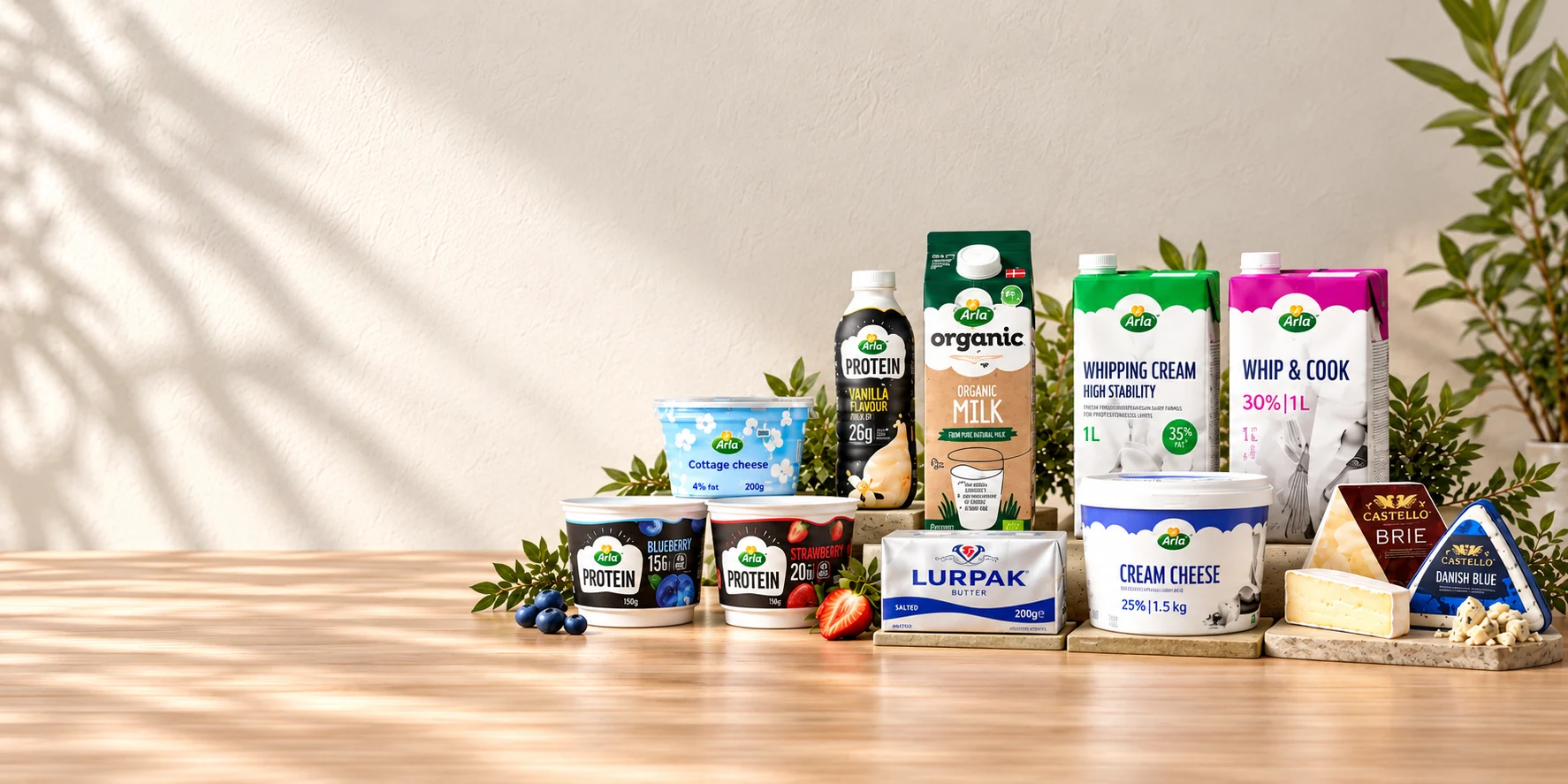
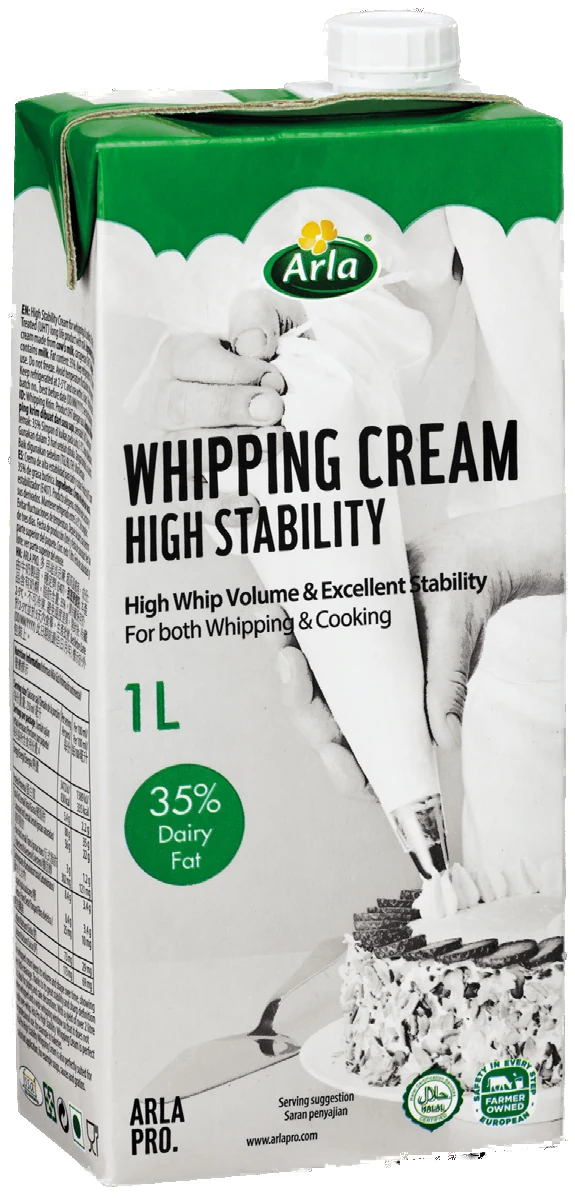
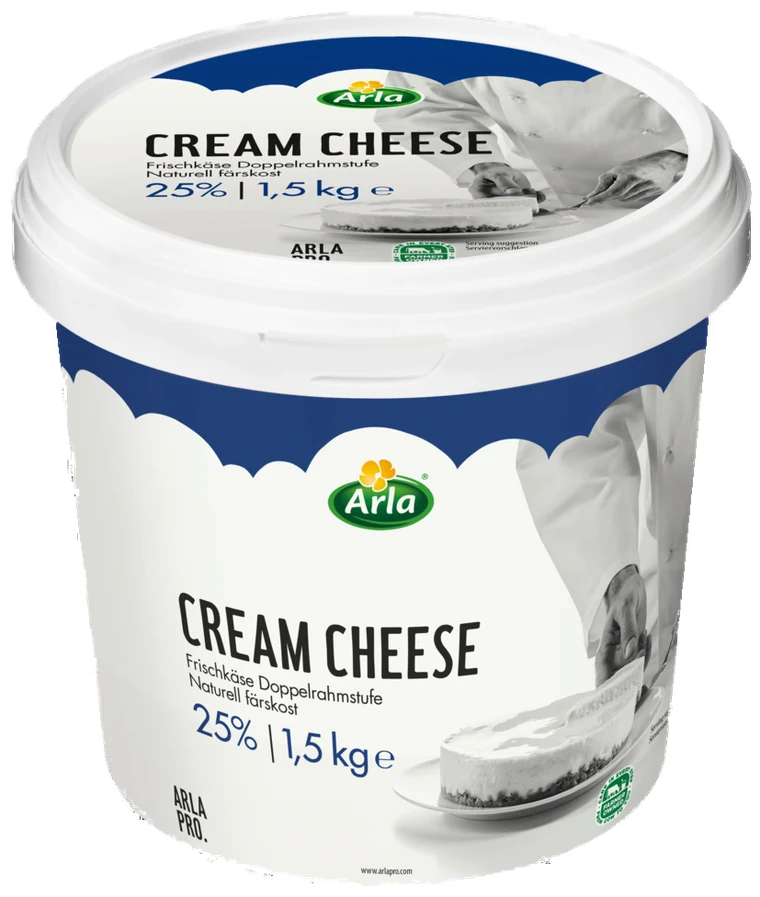
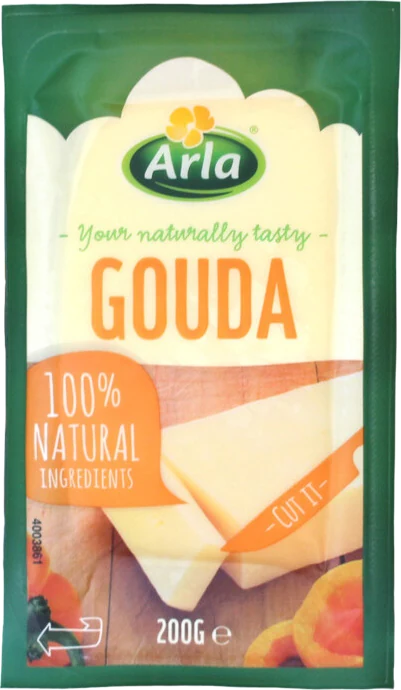
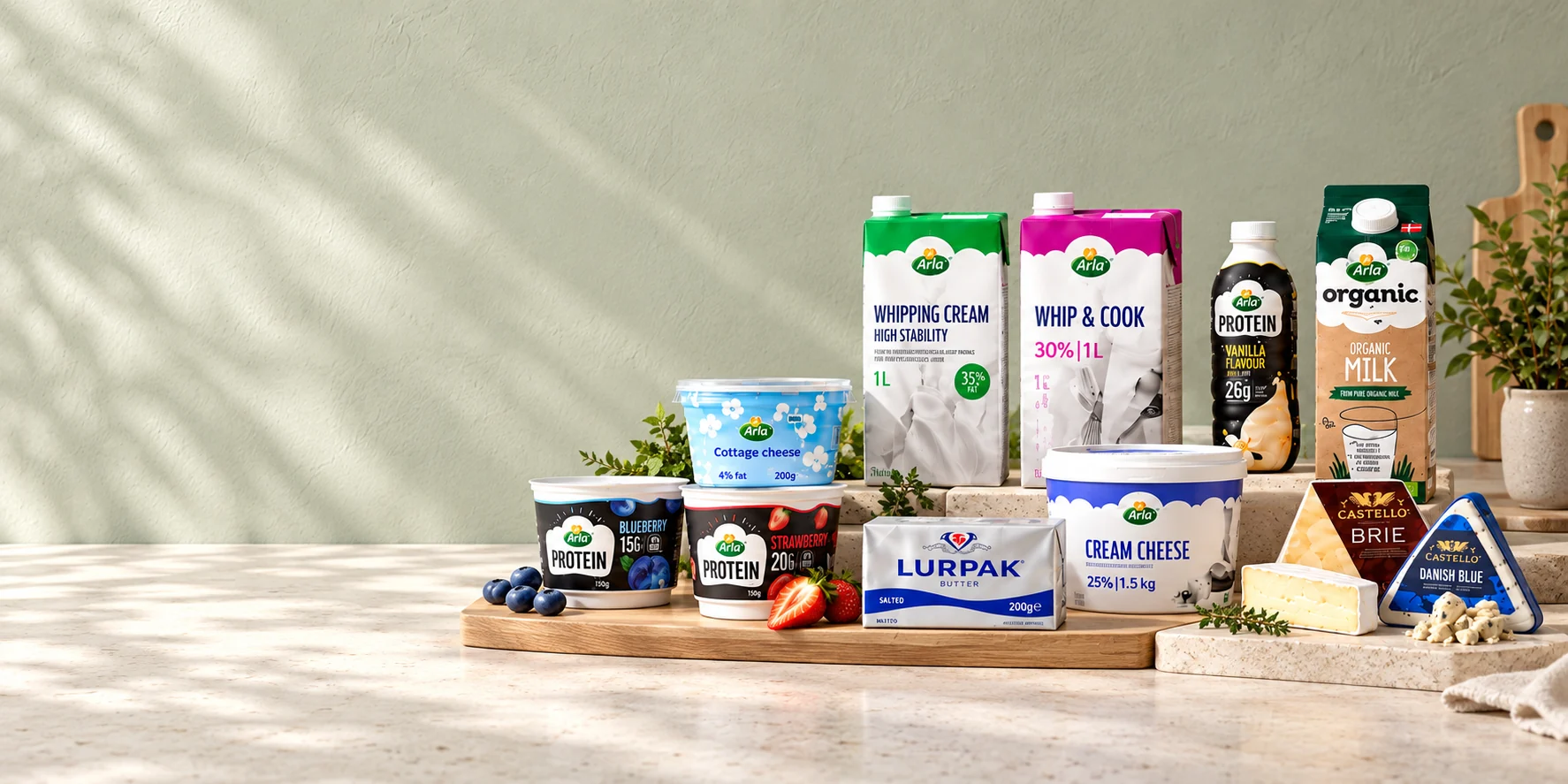
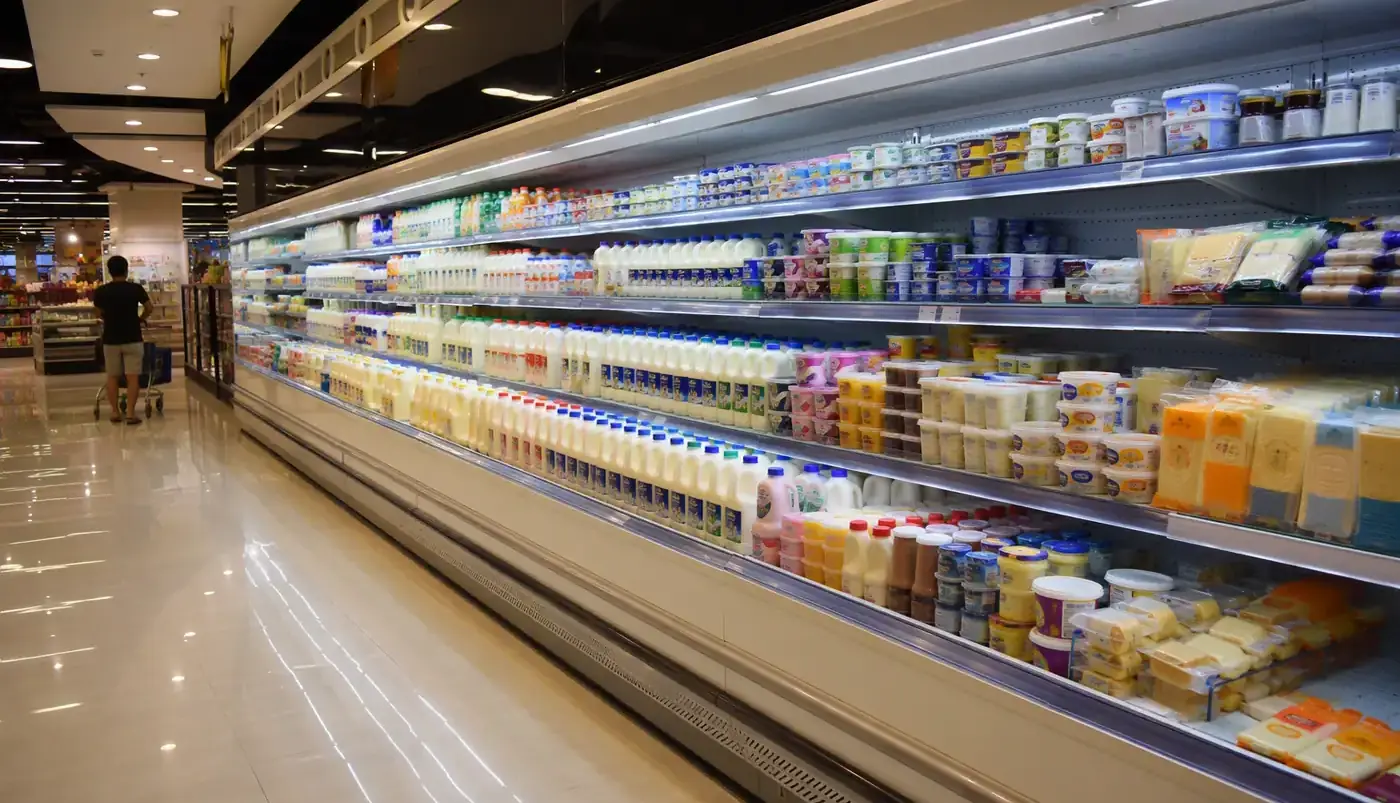
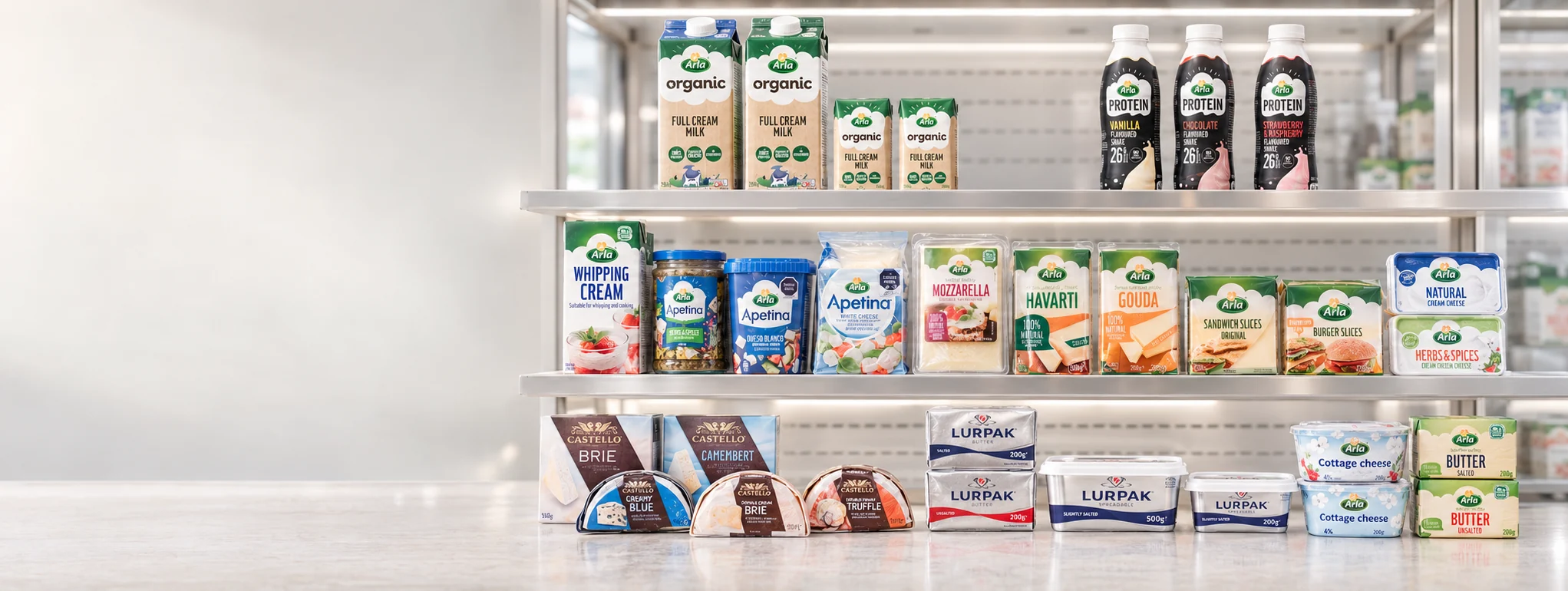
Cheese, butter, milk, cream and cream cheese, in retail packs and foodservice formats. Arla, Arla Pro, Lurpak and Castello, alongside European speciality lines from producers in the Netherlands, Germany, Poland, Italy and France. Read the catalogues below for the lines, the pack sizes and the item numbers.
We are the importer. If you already serve a channel we don't reach directly, we can supply you from stock held here rather than from a container you have to commit to.
If you make dairy and want representation here, this is what you would be handing it to: a dedicated milk room, an owned fleet, FSSC 22000, and buyers who already take our calls.
Retail, foodservice and ecommerce covered by one distributor
What we have learned importing and distributing dairy in Singapore, written for the brand owners, retailers and sub-distributors deciding who to work with.
26 October 2026 · Events
Trade-Pro at SIAL Paris 2026
Four days at the world's largest food exhibition, and the numbers behind the cheese and dairy we saw there.
We import premium European dairy and move it across Singapore from a purpose-built cold chain in Tuas. Cheese, butter, milk, cream and cream cheese reach supermarket shelves, hotel and restaurant kitchens, online grocers and other distributors, six days a week.
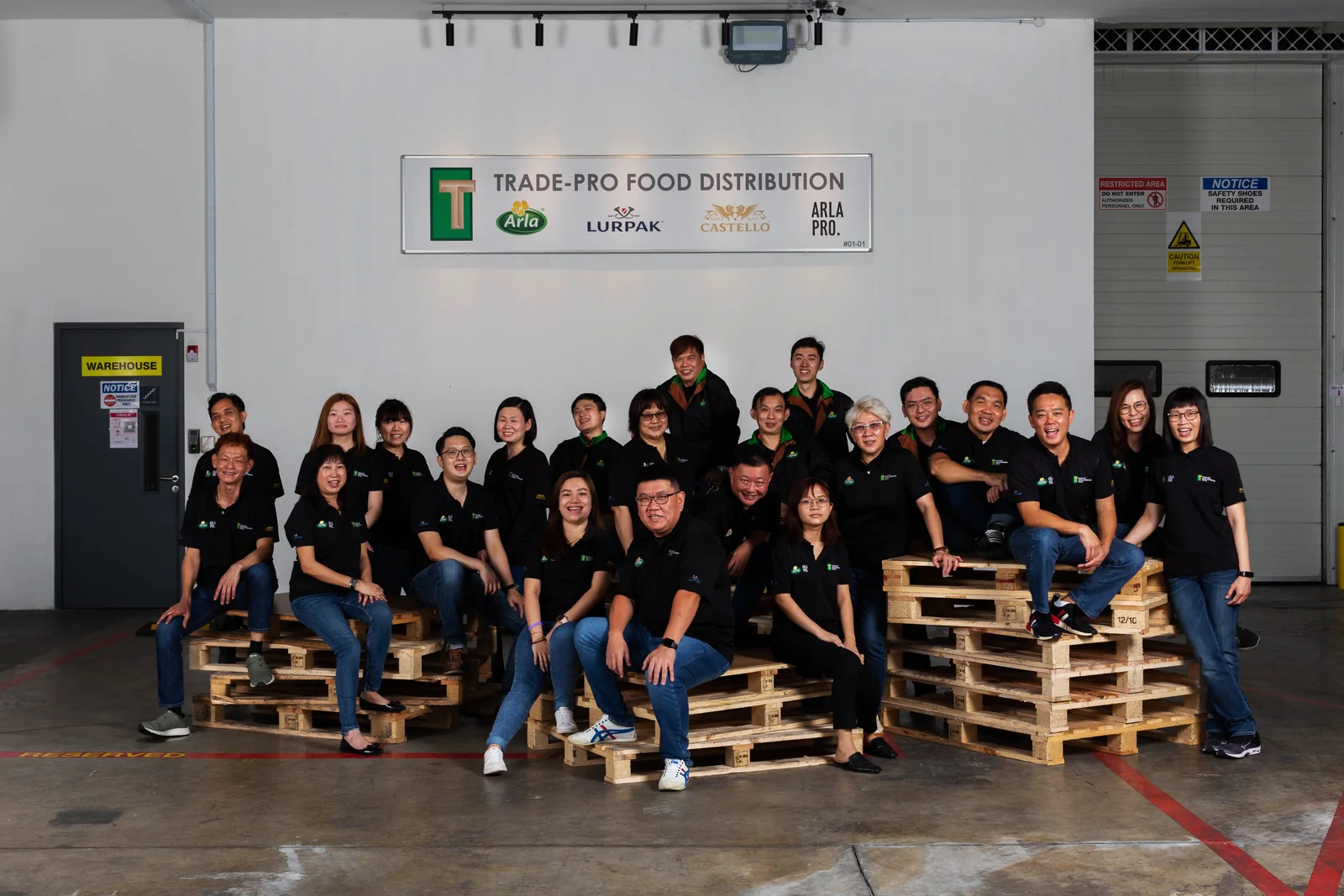
The company was established in 2018 and sits inside Trade-Pro Group, trading since 2009. Small enough that you will know everyone here by name, and part of something large enough that there is somewhere to go next.
Why you would want to be part of our team.
Nobody here sits three steps away from the customer. The order you take and the pallet you load reach a shop shelf or a working kitchen the same week, and you get to see it land.
Health insurance covered in full, with training and progression built into the job
BizSafe Level 3 since 2022, working to a zero lost-time injury target
Rated Silver by EcoVadis and a LowCarbonSG participant, with targets that carry baselines
Ten TAFEP fair employment standards adopted
Our core values.
01
Trust first
You get real responsibility early. We hand people the account, the route or the temperature check and let them own it, because a chain this tight cannot run on everyone waiting to be told. And when something goes wrong, you will not be sorting it out on your own.
02
People and promises
In this trade a date you give someone is a promise about their day. A kitchen has a service that evening, a shop has a shelf to fill, and both have planned around what you told them. We back each other to keep those promises, so a hard week is never one person's to carry.
03
Experience matters
Nobody expects you to arrive knowing the cold chain. The people who have run it for years work alongside the ones who started last month, which is how it gets passed on. What you have actually done here counts for a great deal more than how your CV reads.
04
Learn and change
Dairy distribution does not sit still. Household buying keeps shifting online, kitchens order closer to need than they did a few years ago, and commodity prices can move under a quotation within weeks. That suits people who would rather adjust than wait for things to settle, and you get the room here to do it.
Open roles
Two roles open right now.
If it is not quite you but it is nearly you, write anyway. We would rather read a CV we did not ask for than miss someone good.
Modern trade and ecommerce · Trade-Pro Food Distribution Pte Ltd · Tuas, Singapore
Full time, permanent
Tuas, Singapore
Monday to Friday
Posted 25 September 2026
You would carry the supermarket and online grocery accounts for Arla, Arla Pro, Lurpak and Castello in Singapore. That means the buyers at the major chains, the listings, the trading terms and the promotional calendar, working alongside Arla's own team rather than at arm's length from them.
It suits someone who wants the account to be theirs. You will not be waiting for a head office somewhere else to decide things, and the people who move the stock, clear the paperwork and drive the trucks are in the same building as you.
The role is scoped to the person. Whether it lands at senior executive or assistant manager depends on the experience you bring, and we will settle that between us at the interview rather than before it.
What the job is
Hold and grow the accounts we have, and open the ones we do not
Negotiate trading terms, and own revenue, margin and new listings against a target
Plan campaigns above and below the line with Arla and our trade marketing team
Walk stores with the brand teams, because the shelf tells you things a report will not
Work with our ecommerce channel on campaigns that earn traffic and visibility
Help the head of department with analysis, forecasting and reporting
Get behind the counter and the warehouse when the festive peak arrives
Travel now and then for trade shows and conferences
What you need
Three to five years in sales or key account management, in modern trade or ecommerce
A diploma in marketing, business, media or something near enough
English and Mandarin, to work with our Mandarin-speaking partners and associates
Comfortable in Microsoft Office, and able to build a deck and present it
Self-motivated, and happy owning a number
What comes with it
Monthly sales incentive on top of base
13th month AWS, annual performance bonus and annual increment
Transport allowance, or travel reimbursed if you do not drive
Mobile phone reimbursement and a dental allowance
Corporate healthcare insurance and medical review reimbursement
0830 to 1715, Monday to Friday, at our Tuas office
Foodservice · Trade-Pro Food Distribution Pte Ltd · Tuas, Singapore
Full time
Tuas, Singapore
Posted 5 October 2026
You would look after the foodservice accounts for Arla Pro, Lurpak and Castello in Singapore. That means the hotels, restaurants, caterers and institutional kitchens we already supply, and the ones we don't supply yet.
Most of the job is out with customers: visiting, presenting the range, demonstrating products and following up. The operations, logistics and customer service teams who fulfil your orders work from the same building as you.
The role is scoped to the person. Whether it lands at sales executive or senior sales executive depends on the experience you bring, and we will settle that between us at the interview rather than before it.
What the job is
Look after the hotel, restaurant and institutional accounts we have, and grow them
Find and win new accounts against a sales target
Get to know the chefs, buyers and owners who make the decisions
Visit customers regularly, present the range and run product demonstrations
Prepare quotations, follow up enquiries and close the sale
Work with operations, logistics and customer service so every order arrives as promised
Keep track of market trends, competitors and what your customers need
Support marketing campaigns and promotions
Collect payments on time and keep receivables healthy
What you need
At least three years in sales in foodservice, FMCG or F&B
A record of hitting sales targets
Good at communicating and negotiating, and at building relationships that last
Self-motivated, and comfortable working on your own
A valid Class 3 driving licence, and your own vehicle if the role calls for one
Knowing Singapore's foodservice market is an advantage
What comes with it
Monthly sales incentive on top of base
13th month AWS, annual performance bonus and annual increment
Transport allowance
Mobile phone reimbursement and a dental allowance
Corporate healthcare insurance and medical review reimbursement
Room to progress as your accounts grow
Contact
Let's talk dairy.
Enquiries are routed to the right person by what you select below, so you are not passed around.
Address1 Tuas Bay Close, #01-01 Singapore 636997
Registered entityTrade-Pro Food Distribution Pte Ltd UEN 201807184G
Later ships, longer routes: what 2026 did to chilled food supply
The Middle East war kept Europe's ships on the long way round, and half arrived late. What it meant for dairy coming into Singapore, and how we adjusted.
The ships that bring Europe's chilled food to Asia spent most of 2026 on the long route round Africa, and fewer of them arrived on time than at any point since 2022.
Only 49.9 per cent of container ships worldwide arrived on schedule in August, according to the maritime data firm Sea-Intelligence.
Ships that arrived late were, on average, 6.81 days behind.
For an importer of butter, cheese and cream travelling in refrigerated containers from northern Europe, a week's delay at sea is a week of stock that has to be planned for on land.
Eight months on the long way round, and a slow return to SuezShipping and food supply events affecting Singapore, 2026
DisruptionRecovery
28 Feb
The Middle East war begins
Singapore's Ministry of Home Affairs dates the conflict from 28 February.
1 Mar
Plans to return to Suez are dropped
Hapag-Lloyd, Maersk and CMA CGM pause planned Suez sailings and send ships round the Cape.
Early Mar
The Strait of Hormuz is effectively closed
Fuel prices climb. Singapore diesel goes from S$2.66 a litre on 23 February to S$3.56 to S$3.73 by 21 March.
25 Mar
Emergency fuel surcharges on refrigerated containers
Maersk charges up to US$600 per reefer container.
7 Apr
Parliament is told imported food prices will rise
Minister K Shanmugam says fuel costs will make food dearer to transport and store.
22 Apr
SFA warns of gaps on some shelves
Some foods from certain countries may become temporarily unavailable. Dairy is not among the items named.
Aug
Half of all container ships arrive late
Global schedule reliability falls to 49.9 per cent, the lowest since September 2022.
19 to 24 Sep
The Asia to northern Europe loop returns to Suez
Maersk and Hapag-Lloyd move four services, including AE5, back through the canal.
Early Oct
Suez traffic passes half its pre-crisis level
The first time since the Red Sea attacks of late 2023.
7 to 13 Oct
Ships wait three to five days for a berth in Singapore
Yards at PSA Singapore are close to full ahead of China's Golden Week holiday.
13 Oct
A Singapore-registered ship sinks in Hormuz
GFS PRIDE is struck and later sinks. All 21 crew are evacuated.
Sources: Ministry of Home Affairs; WorldCargo News; Mothership; Ship & Bunker; Business Times; Sea-Intelligence; gCaptain; BIMCO and Clarksons; Kuehne+Nagel; Maritime and Port Authority of Singapore.
A detour that was meant to end
Most container services between Asia and northern Europe have sailed round the Cape of Good Hope since attacks on shipping in the Red Sea in late 2023.
Between 2024 and mid-2026, only 8 per cent of capacity on routes that could use either Suez or the Cape went through the canal, against 80 per cent before the attacks, the shipping association BIMCO said, citing Clarksons data.
Carriers were preparing to bring services back through Suez early this year.
The war that began on 28 February ended those plans: on 1 March, Hapag-Lloyd, Maersk and CMA CGM paused planned Suez sailings and sent ships round the Cape, WorldCargo News reported.
The Cape route adds 10 to 14 days to a voyage between Asia and Europe, the freight analytics firm Xeneta said in August, citing GoFreight.
The Strait of Hormuz, which ships between Europe and Singapore do not need to pass, was effectively closed from the first days of March.
Its effect on Singapore arrived through fuel.
Costs along the way
Caltex diesel in Singapore cost S$2.66 a litre on 23 February and between S$3.56 and S$3.73 by 21 March, Mothership reported.
Maersk added an emergency bunker surcharge of up to US$600 per refrigerated container from 25 March, according to Ship & Bunker.
Minister K Shanmugam told Parliament on 7 April that "the prices of our imported food products will rise".
"As fuel costs go up, it will also cost more to transport and store food products."
Minister K Shanmugam, ministerial statement in Parliament, 7 April 2026
On 22 April the Singapore Food Agency said some food items from certain countries could become temporarily unavailable, Business Times reported.
The examples it gave included Scandinavian salmon. Dairy was not among them.
SFA's food security page, updated on 18 October, says the blockade of the Strait of Hormuz "could translate to higher logistics cost".
49.9%
Container ships worldwide that arrived on schedule in August, the lowest since September 2022
Sea-Intelligence, 29 September 2026
6.81 days
Average delay of the ships that arrived late in August
Sea-Intelligence, 29 September 2026
US$600
US dollars: Maersk's emergency fuel surcharge per refrigerated container, from 25 March
Ship & Bunker, 12 March 2026
Ships are returning to Suez
The shorter route is reopening.
Maersk and Hapag-Lloyd moved four services back through Suez from 19 to 24 September, including AE5, their loop between Asia and northern Europe, gCaptain reported.
In the first two weeks of October, container ships carried 753,000 TEU a week through the canal, against 1,457,000 TEU in the same weeks of 2023.
Niels Rasmussen, chief shipping analyst at BIMCO, said it was "the first time that transits have exceeded 50% of pre-disruption levels".
Ships are coming back to Suez, but most still go round AfricaShare of container capacity on routes that can use either Suez or the Cape of Good Hope that went through Suez, per cent
80%Before the Red Sea attacks
8%Average, 2024 to mid-2026
36%Early October 2026
Source: BIMCO, using Clarksons data, reported by WorldCargo News, 14 October 2026.
The return is "adding further capacity" to the route between Asia and Europe, the freight consultancy Drewry said on 15 October.
The Strait of Hormuz remains restricted.
On 13 October the Singapore-registered container ship GFS PRIDE was struck there and later sank, the Maritime and Port Authority of Singapore said. All 21 crew were evacuated.
What about online shopping?
Cross-border online shopping from China is often put forward as a reason freight is tight.
For air cargo, it was true for a time.
After the United States ended duty-free entry for low-value Chinese parcels in May 2025, "China-Europe e-commerce is now soaking up a lot of freighter capacity", Alain Tulpin, chief executive of the perishables forwarder Tulpin Group, told The Loadstar in November 2025.
That boom has cooled.
China's exports of low-value and e-commerce goods fell 7 per cent year on year in May 2026, according to Xeneta, and the European Union introduced a €3 duty on each low-value parcel from 1 July.
"E-commerce was air freight's single biggest growth pillar, but that is no longer the case," Xeneta's chief airfreight officer Niall van de Wouw said in July.
Not all of it flies.
Taobao's own consolidation service sends orders to Singapore by sea, taking 12 to 20 days, according to a ShopBack guide published in July.
That freight lands at the same port as Europe's dairy.
The Port of Singapore handled a record 44.66 million TEU in 2025, up 8.6 per cent, the Maritime and Port Authority said in January.
In the week to 13 October, ships were waiting three to five days for a berth at PSA Singapore and the yards were close to full, the logistics group Kuehne+Nagel reported.
It put the congestion down to strong demand ahead of China's Golden Week holiday and a backlog of cargo bumped to later sailings.
We have not found any measure of how much of that demand is online shopping and how much is ordinary trade.
For an importer, the port is where the two meet: European dairy and Chinese parcels come through the same terminals in Singapore.
The last leg
Delivery inside Singapore carries its own costs.
The certificate of entitlement for goods vehicles and buses reached a record S$95,000 in July.
Transport Minister Jeffrey Siow told Parliament on 4 August that the rise was likely due to more registrations of electric heavy goods vehicles and electric buses.
Electricity, which keeps cold stores running, has eased for now.
SP Group's regulated tariff for October to December is 28.59 cents per kWh before GST, 10.4 per cent lower than the previous quarter, and SP Group has said tariffs are expected to rise in the following quarter if fuel costs stay high.
What we changed
Trade-Pro made two changes this year.
We moved our orders with European suppliers earlier wherever we could.
And we asked customers to forecast further ahead, so that stock for the weeks when a ship might arrive late is ordered in time.
"When a ship can arrive a week late, an order has to cover more than the week it is placed in. The earlier a customer tells us what they will need, especially ahead of a busy period, the earlier we can put it on a ship."
Roger Yee, General Manager, Operations and Food Services, Trade-Pro Food Distribution
For retail buyers and kitchens, the change that helps most is sharing forecasts for peak periods early, particularly before December, the busiest month of the year for dairy.
"This year showed that a cold chain is only as reliable as the voyage that feeds it. We cannot shorten the route round Africa, but we can plan further ahead with our customers, and that is where we have put our effort."
Eugene Toh, Director, Trade-Pro Food Distribution
Plan your supply with us
Trade-Pro Food Distribution imports chilled and frozen European dairy and supplies retail, foodservice and ecommerce customers across Singapore from its cold chain in Tuas.
Four days at the world's largest food exhibition, and the numbers behind the cheese and dairy we saw there.
A team from Trade-Pro Food Distribution spent four days at SIAL Paris, the international food exhibition held at Paris Nord Villepinte from 17 to 21 October.
Director Eugene Toh, General Manager Roger Yee, Head of Retail James Lin and Sharon Bay, Deputy General Manager for Procurement and Admin, attended from 17 to 20 October.
SIAL is held every two years and is the largest food trade show in the world by its organiser's count.
Most of the team's time went on cheese and dairy, the category Trade-Pro imports into Singapore.
8,000
Exhibitors expected, up from 7,500 at the 2024 show
SIAL Paris, pre-show projection
295,000
Trade visitors expected over five days
SIAL Paris, pre-show projection
12 halls
About 280,000 square metres at Paris Nord Villepinte
The Food Institute, 23 Oct 2026
SIAL Paris is back above its pre-pandemic sizeExhibitors at each edition. The 2020 show was cancelled; the 2026 figure is the organiser's projection
ReportedProjected
7,2002018
7,0002022
7,5002024
8,0002026
Sources: Interempresas, 2 Nov 2018; Comexposium, 25 Oct 2022; ESM Magazine, 28 Nov 2024; SIAL Paris pre-show figures, 2026.
Where Singapore's cheese comes from
Singapore imported US$146.2 million of cheese in 2025, according to its trade figures reported to UN Comtrade.
By weight that was 19,620 tonnes, 14 per cent more than in 2024.
Australia and New Zealand are the largest suppliers, as they are for most dairy here.
The European Union's share rose from 31.4 per cent of cheese imports by value in 2019 to 35.2 per cent in 2025.
Butter follows a similar pattern: New Zealand supplied 42.7 per cent in 2025, while Denmark, the home of Lurpak, almost doubled its share from 5.0 per cent in 2019 to 9.3 per cent.
Australia and New Zealand supply the most cheese. The EU supplies about a thirdSingapore cheese imports by country of origin, 2025, US$ million. Countries the team met producers from are highlighted
Australia
US$30.8m
New Zealand
US$22.2m
Italy
US$15.7m
United States
US$15.2m
France
US$11.6m
Denmark
US$7.0m
Netherlands
US$4.6m
Germany
US$4.1m
Source: UN Comtrade, imports reported by Singapore, HS 0406 (cheese and curd), CIF values. Total cheese imports were US$146.2 million in 2025.
Italy, rising
Cheese from Italy has grown faster than from any other large supplier.
Imports from Italy doubled from US$7.7 million in 2019 to US$15.7 million in 2025, and rose 45 per cent in the last of those years alone.
That took Italy from fifth to third among Singapore's cheese suppliers, ahead of France and the United States.
Italian cheese into Singapore has doubled since 2019Singapore cheese imports from Italy, US$ million
7.72019
8.12020
8.62021
9.82022
10.42023
10.82024
15.72025
Source: UN Comtrade, imports reported by Singapore, HS 0406, CIF values. By weight, imports rose from 715 tonnes to 1,430 tonnes.
Two of the team's stops were Italian.
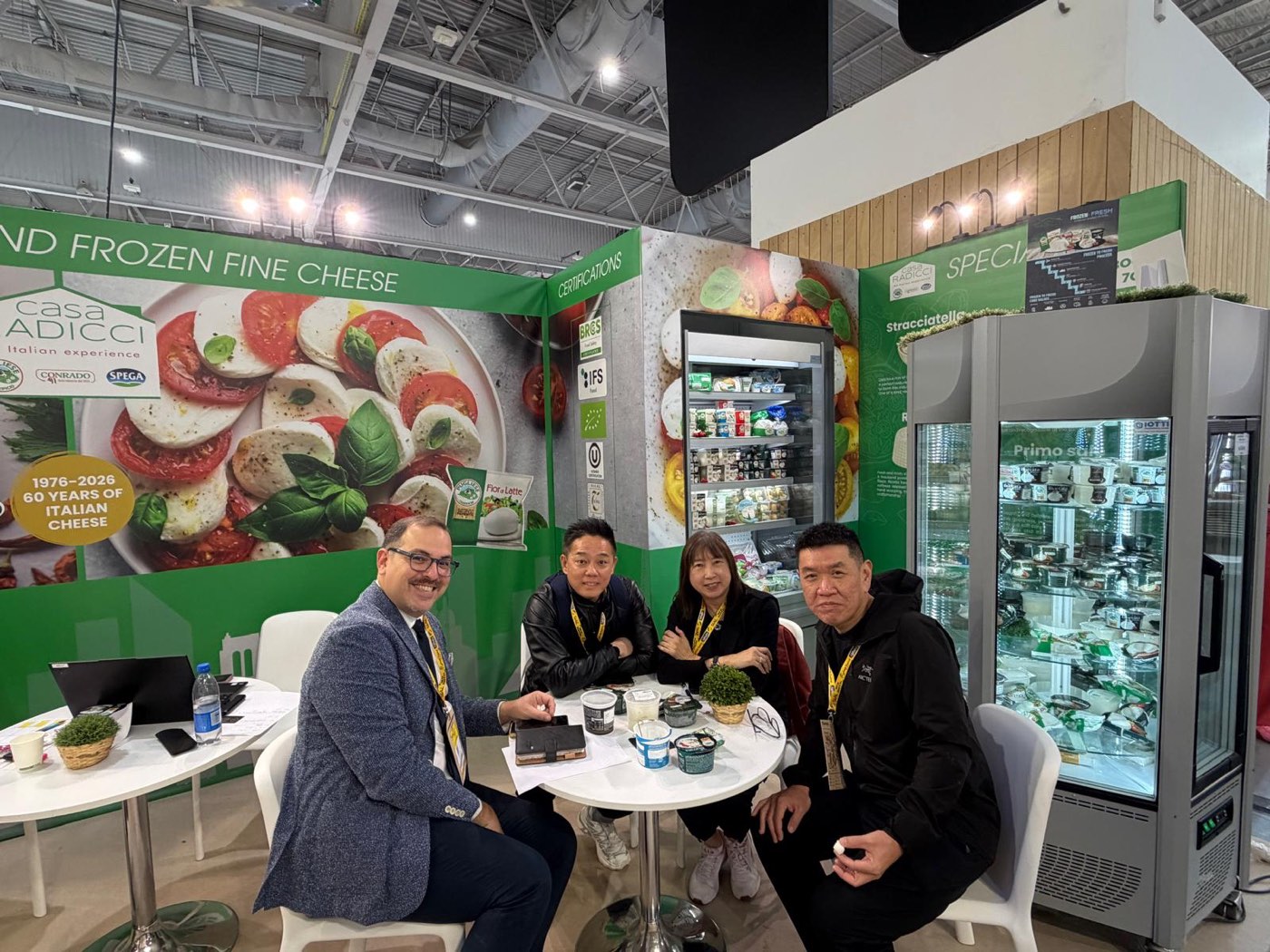
Casa Radicci, which makes fresh and frozen Italian cheese, marked 60 years in business on its stand, from 1976 to 2026. Its range includes fior di latte and stracciatella.
At the Casa Radicci stand.
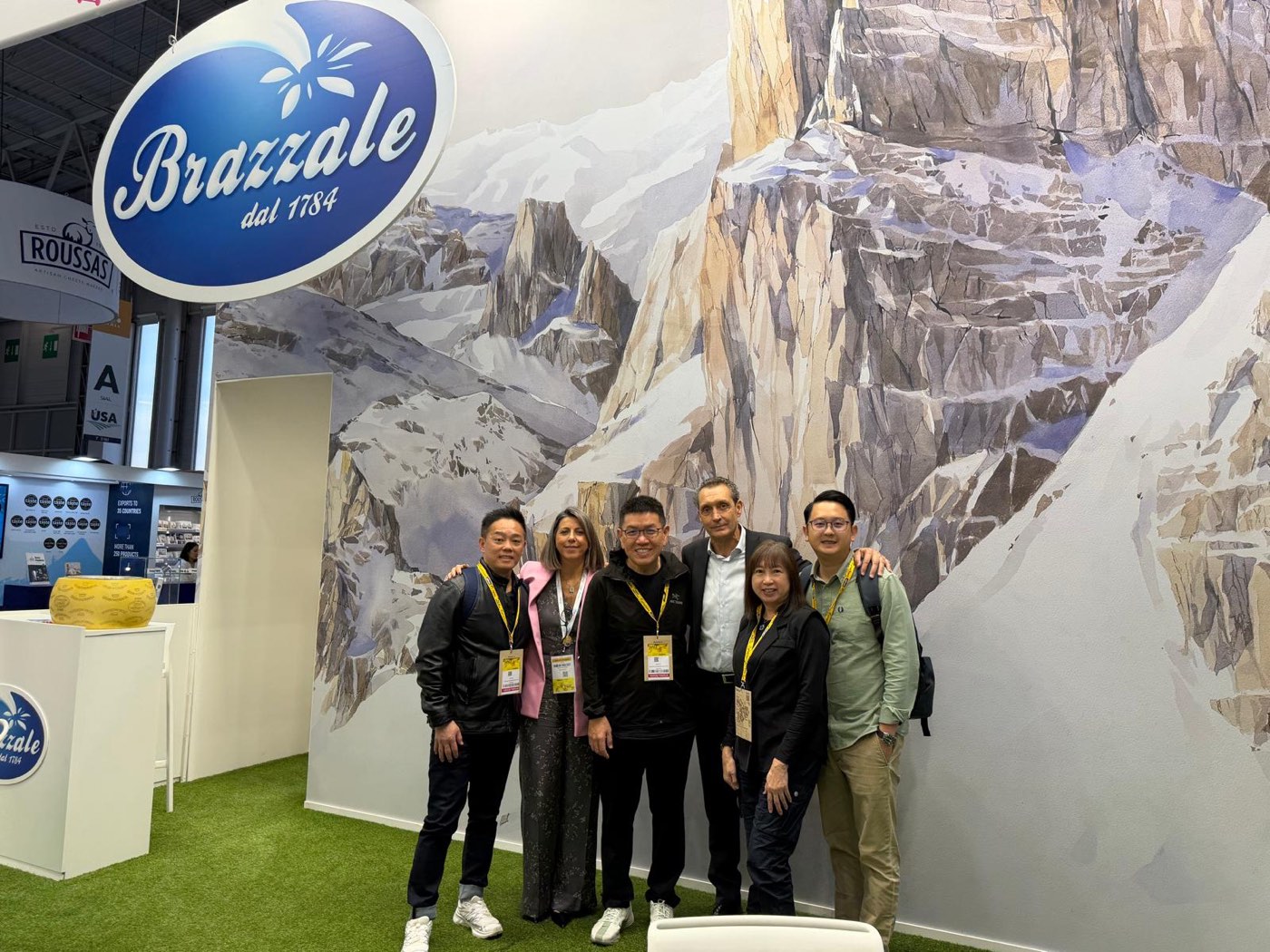
Brazzale, an Italian dairy business that dates its history to 1784, was the other.
Italy exported 680,000 tonnes of cheese worth €6.1 billion in 2025, up 12.8 per cent in value, the Italian dairy association Assolatte said in March.
Mozzarella exports passed €1 billion for the first time, up from €354 million in 2015, according to ISTAT data reported by Great Italian Food Trade.
Assolatte has also warned that fresh cheeses such as mozzarella, burrata and stracciatella are at risk in Asian markets from the longer shipping route round Africa.
At the Brazzale stand.
Paying for origin
European cheese reaches Singapore at a higher price per kilo than cheese from Australia or New Zealand.
In 2025, French cheese was imported at about US$13.10 a kilo and Italian at about US$11, against about US$6.50 for Australian, on Singapore's import figures.
European cheese arrives at a higher price per kiloAverage value of Singapore cheese imports by origin, 2025, US$ per kg
France
US$13.1
Italy
US$11.0
Netherlands
US$8.7
Australia
US$6.5
New Zealand
US$5.9
Source: UN Comtrade, imports reported by Singapore, HS 0406, 2025: import value divided by net weight. Values include freight and insurance.
Some of that premium is in the name.
Twenty-four European cheeses are registered as geographical indications in Singapore, which reserves their names for cheese made in the place and the way their rules set out.
Ten are Italian and eight French. No Dutch cheese is on the list.
24 European cheese names are protected in Singapore. None is DutchCheeses registered as EU geographical indications in Singapore, by country
Italy 10
AsiagoFontinaGorgonzolaGrana PadanoMozzarella di Bufala CampanaParmigiano ReggianoPecorino RomanoPecorino ToscanoProvolone ValpadanaTaleggio
France 8
Brie de MeauxCamembert de NormandieComtéEmmental de SavoieMont d'OrMorbierReblochonRoquefort
Spain 2
IdiazabalQueso Manchego
Denmark 1
Danablu
Greece 1
Feta
Cyprus 1
Halloumi
Portugal 1
Queijo S. Jorge
Source: EU IP Key Southeast Asia, Geographical Indications and the EU-Singapore Free Trade Agreement, 2023.
Protection has limits. In November 2024 Singapore's Court of Appeal ruled that "Parmesan" is not a translation of Parmigiano Reggiano, so cheese sold as Parmesan here does not have to be Parmigiano Reggiano.
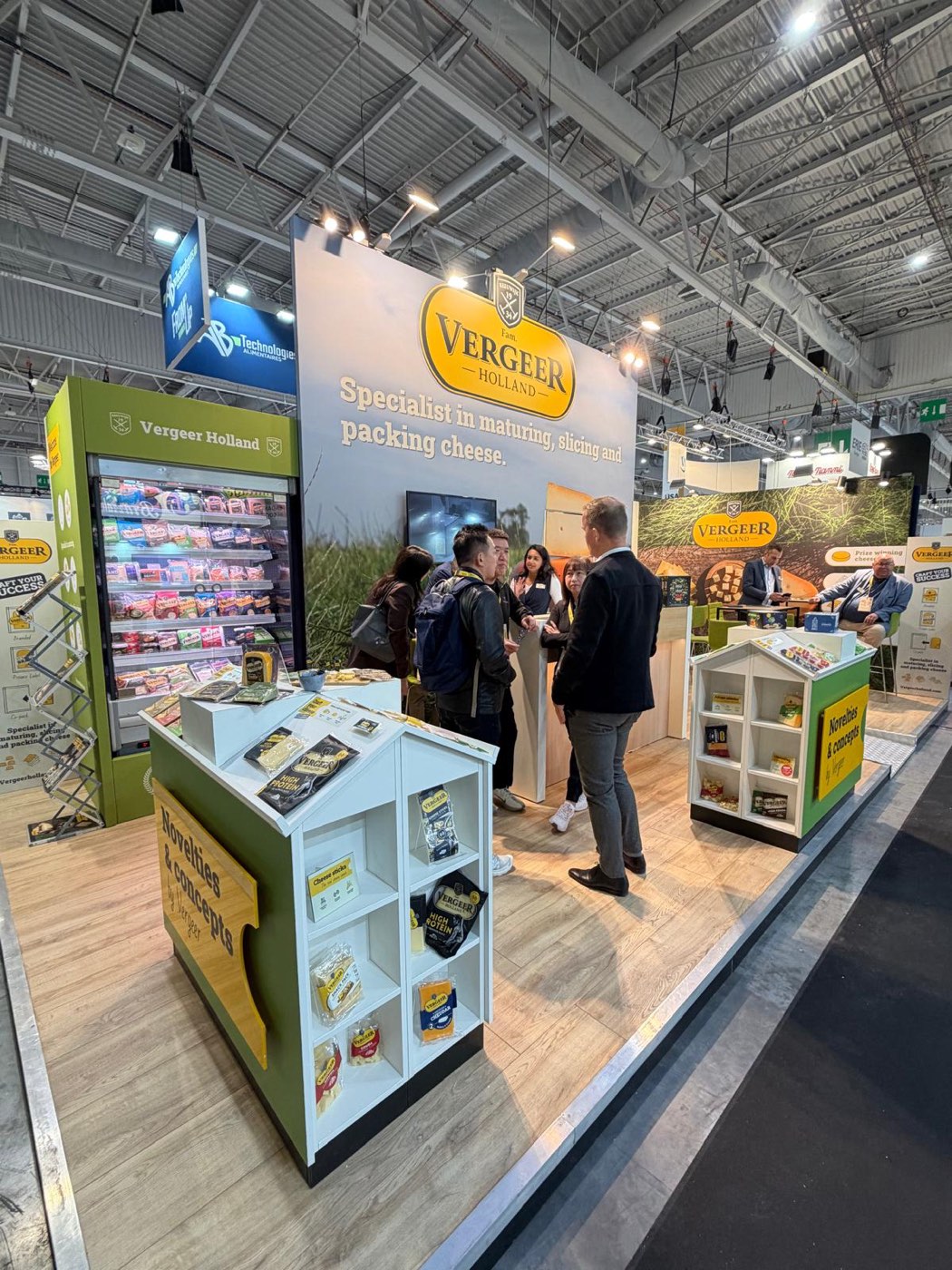
Vergeer Holland, a Dutch specialist in maturing, slicing and packing cheese, competes on format rather than a protected name.
The Vergeer Holland stand, with its high-protein cheese and cheese sticks at the front.
"A show like SIAL is the one place I can taste the product, see the pack and ask about lead times in the same conversation. With ships running a week late this year, the lead time matters as much as the price."
Sharon Bay, Deputy General Manager, Procurement and Admin, Trade-Pro Food Distribution
Protein on the dairy stands
High protein was on more than one dairy stand.
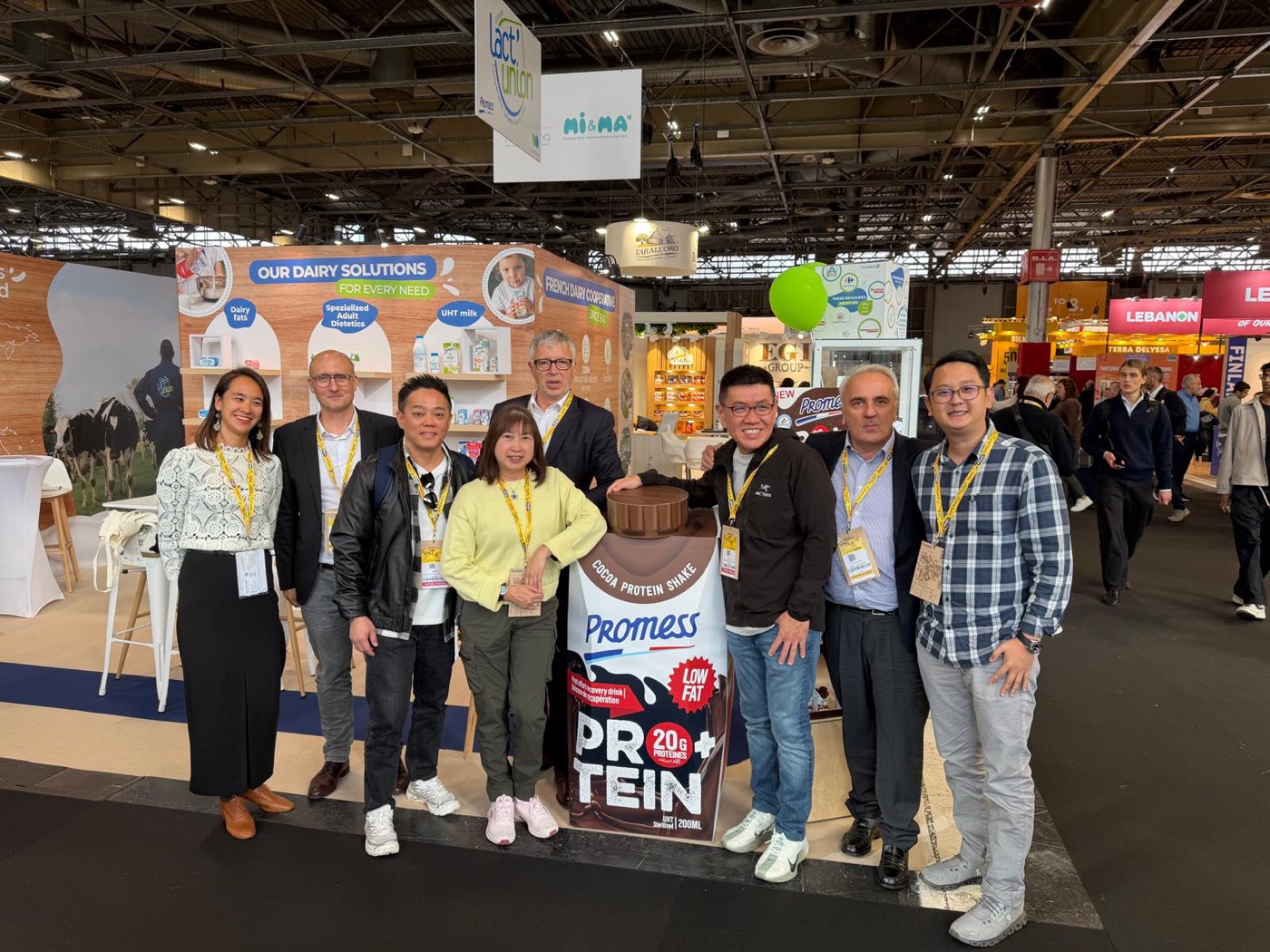
At Lact'union, a French dairy cooperative, the team saw Promess Protein+, a cocoa protein shake with 20g of protein in a 200ml carton, sold as a recovery drink after exercise. Vergeer Holland showed a high-protein cheese.
In the United States, dairy carrying a protein claim grew 13.7 per cent by value in the year to July, against 2 per cent for dairy as a whole, the market research firm Circana found.
In the US, dairy with a protein claim is growing almost seven times faster than dairy overallGrowth in US dairy sales by value over the year to July 2026, per cent
Dairy with a protein claim
+13.7%
All dairy
+2.0%
Source: Circana, reported by FoodNavigator-USA, 20 Oct 2026. Protein-claim dairy was a US$10.4 billion segment of a US$104 billion market.
The same demand is behind Arla Protein, which grew 34.4 per cent in the first half of 2026 by Arla's measure and which Arla Foods launched in Singapore on 18 September with Trade-Pro as its main distributor.
"SIAL puts more of Europe's dairy producers in one place than anywhere else we go. Tasting a product with the people who make it tells us more than a specification sheet, and it is how we decide what is worth bringing to Singapore."
Eugene Toh, Director, Trade-Pro Food Distribution
Evenings in Paris
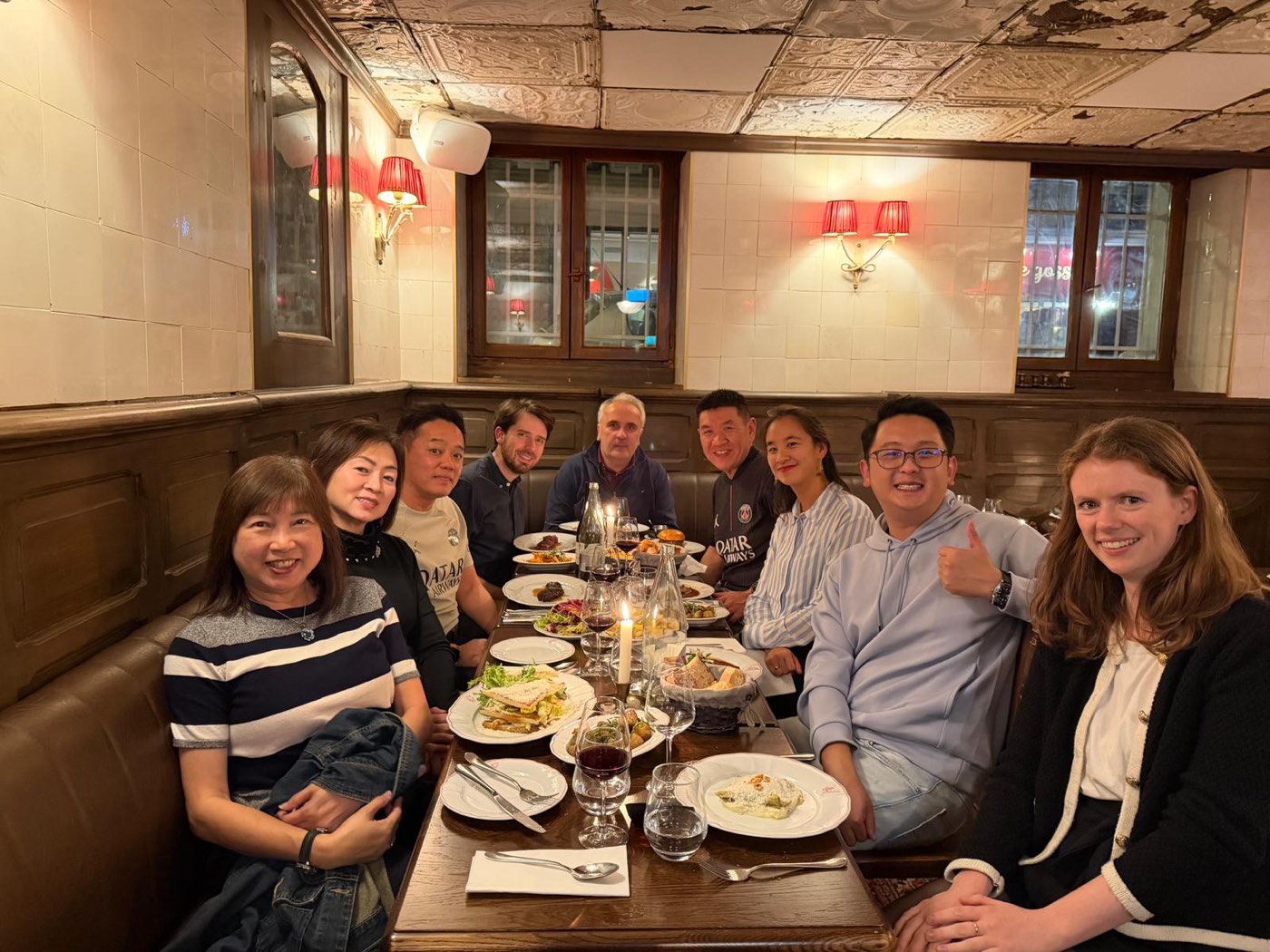
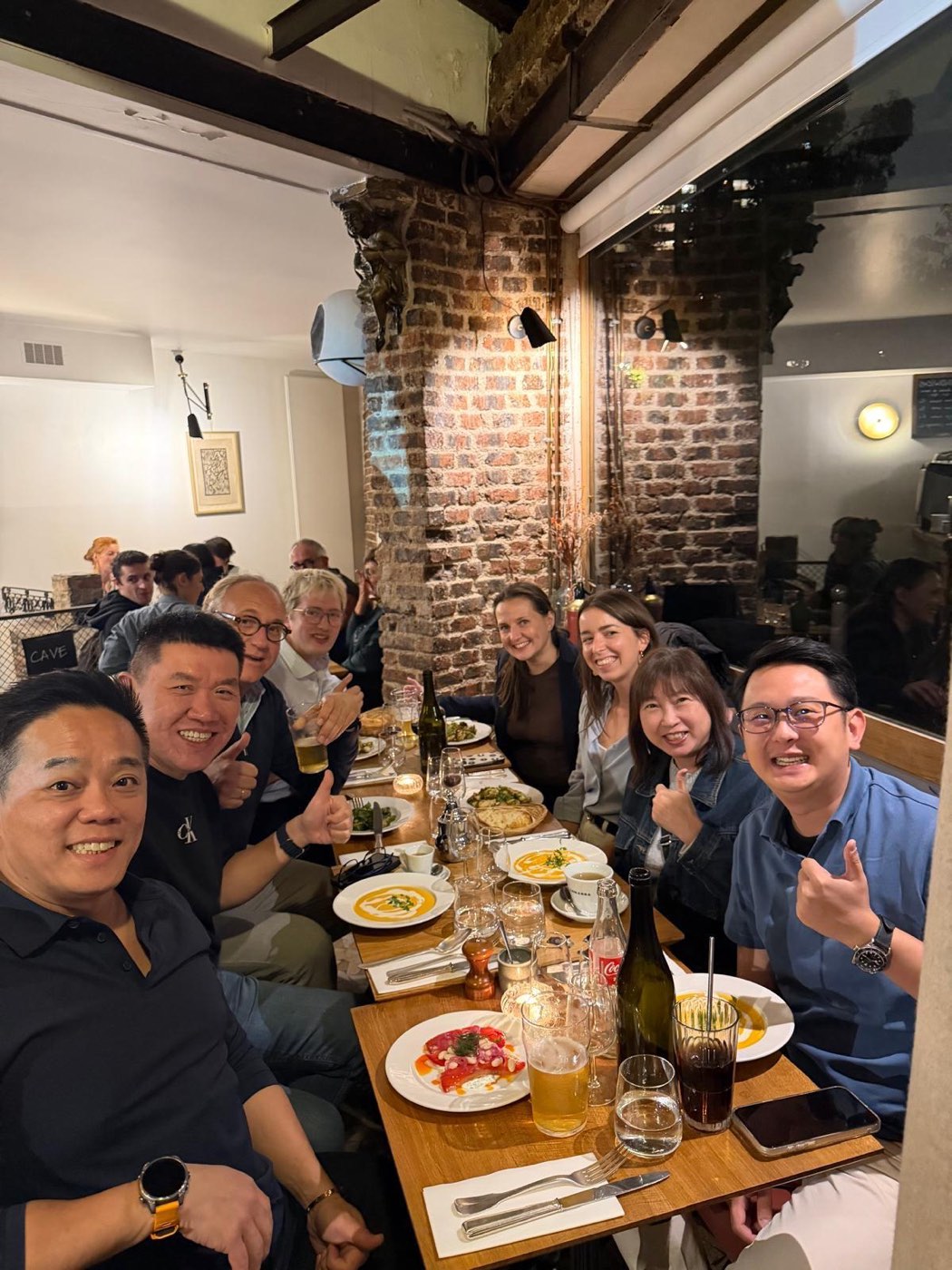
The evenings went to dinners with European partners, two of them pictured here.
Dinner in Paris during the show.A second evening, a second table.
What 2027 may bring
The analysts who track dairy expect a tighter year ahead.
Global milk supply grew about 2.2 per cent in 2026 and is forecast to grow 1 per cent in 2027, the Irish dairy group Ornua said in October.
Global milk supply growth is expected to halve in 2027Change in global milk supply, per cent, Ornua estimate for 2026 and forecast for 2027
EstimateForecast
+2.2%2026
+1.0%2027
Source: Ornua, October 2026, reported by DairyReporter, 13 Oct 2026.
Ornua described butter prices in August and early September as "historically low".
Milk supplyLess milk growth
Rabobank expects output from the seven largest dairy exporters to contract in the last quarter of 2026 and stay roughly flat through the first half of 2027.
Rabobank, Global Dairy Quarterly Q3 2026, 9 Sep 2026
PricesPowders lead, fats steady
Rabobank expects milk powders and proteins to be the strongest part of the market, with butterfat well supplied and cheese pressured by new capacity.
Rabobank, 9 Sep 2026
ShippingA shorter route back
Suez container transits passed half their pre-crisis level in early October. If the return holds, voyages from Europe shorten. The Strait of Hormuz remains restricted.
BIMCO and Clarksons, via WorldCargo News, 14 Oct 2026
TradeNeighbours open up to EU dairy
The EU and Indonesia agreement is expected to take effect on 1 January 2027 and remove tariffs on EU dairy. The EU and the Philippines reached substantial agreement on a trade deal in September.
EU External Action Service; European Commission, 22 Sep 2026
"Paris shows us what Europe is making. Whether it comes to Singapore depends on whether a shopper here will pick it up at a price that works on the shelf, and that is the conversation we take back to our retail partners."
James Lin, Senior Manager and Head of Retail, Trade-Pro Food Distribution
SIAL Paris returns in 2028.
Bringing a dairy brand to Singapore?
Trade-Pro Food Distribution imports European dairy and supplies retail, foodservice and ecommerce customers across Singapore from its cold chain in Tuas.
Recall of Arla Protein Salted Caramel Flavour Pudding, 200g
27 October 2026 · Trade-Pro Food Distribution Pte Ltd
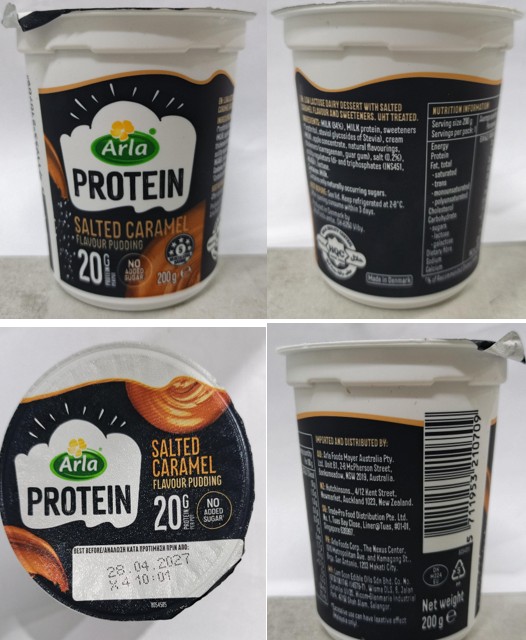
The Singapore Food Agency has directed a recall of Arla Protein Salted Caramel Flavour Pudding, 200g, with a best-before date of 28 April 2027, as a precautionary measure due to the potential presence of glass fragments.
SFA said the recall follows a notification from Food Standards Australia New Zealand. The product is made in Denmark. Trade-Pro Food Distribution imports and distributes it in Singapore and does not manufacture it. We are working closely with Arla and with retailers to remove the affected product from sale.
We are here to help
We know a recall is worrying, especially if you or your family have already eaten the product. Your safety comes first, and our team is ready to help, whether you have a question about the product, need help with a refund or are not sure what to do next.
The affected product. Image: Singapore Food Agency.
Product
Arla Protein Salted Caramel Flavour Pudding
Pack size
200g
Best before
28.04.2027
Country of origin
Denmark
The best-before date is printed on the lid, as shown in the photo.
The regulatory route in is shorter than most European producers expect. No plant accreditation, a registration your distributor already holds, and permits measured in working days.
For brand owners considering Singapore distribution
Most European dairy producers we speak to arrive expecting Singapore to treat milk and cheese the way it treats meat and seafood, with plant-level approvals, competent authority negotiations and a two-year wait.
It does not.
The route in is shorter than people expect, and knowing that changes how you plan a launch.
Dairy is registered, not licensed
The Singapore Food Agency splits importers into two groups.
Meat and fish products, fresh fruit and vegetables, and shell eggs need a licence.
Processed food, which is where dairy sits, needs a registration. Registration is the lighter of the two, and it is held by the importer rather than by you.
Before that registration can exist, the importing company needs a UEN from ACRA, activated with Singapore Customs for import and export.
Any established distributor will have held both for years.
You almost certainly do not need establishment accreditation
This is the part that surprises people.
SFA maintains a list of food categories that can only be imported from overseas farms and establishments it has accredited, and accreditation has to be applied for by the exporting country's competent authority rather than by you.
That process is slow and political.
The list has five entries: meat and meat products, live poultry, shell eggs, processed eggs, and fish and fish products.
Dairy is not on it.
So if you make butter in Denmark or hard cheese in the Czech Republic, your plant does not need to be individually approved by Singapore before its product can land here.
That removes the single longest lead time most producers budget for.
One genuine restriction does apply. Raw liquid milk cannot be imported, and only processed dairy meeting SFA's conditions comes in.
Every shipment needs its own permit
Registration gets you standing. It does not get product through the port.
Each consignment needs an import permit applied for through TradeNet, Singapore's single-window trade system.
In practice that means classifying the product correctly, confirming the requirements that attach to that classification, submitting supporting documentation, and paying a per-consignment fee that runs from a few dollars to a few hundred depending on category.
SFA asks for at least one working day to process a permit.
One working day sounds trivial until a Friday afternoon arrival becomes a Monday clearance, and chilled product sitting at the port is chilled product losing shelf life.
Your labels probably need work
Singapore's prepacked food labelling requirements changed on 30 January 2026, gazetted a year earlier.
If your artwork was signed off before that, assume it needs review.
Country of origin now has to be stated as a country. "Made in France" is fine, and a city or a province on its own is not.
Plenty of European artwork leads with a region, because at home the region is the selling point.
Every prepacked food needs an identification mark, a lot or batch or serial number, that identifies the producing factory and the production lot.
If your traceability lives in a system rather than on the pack, that has to change.
The ingredient list now needs an explicit heading marking it as the ingredient list. It is a small change and a reprint either way.
Carryover additives that still do something in the finished product have to be declared, even though they came in through an ingredient rather than being added directly.
Gluten claims now have fixed thresholds. Gluten-free means 20 mg/kg or less, and reduced-gluten means above 20 and up to 100.
A naturally gluten-free food cannot be labelled as a special dietary food on that basis alone.
The standing requirements still apply on top: name or description of the food, ingredients, allergens, net quantity, importer and distributor details, date marking, and a nutrition information panel.
Where the standards live
Dairy has its own section of Singapore's Food Regulations.
Milk and milk products run from regulation 93 to 125, with ice cream and frozen confections at 126 to 129.
If you make something that sits near a category boundary, a soft cheese that behaves like a spread or a drink with a dairy base and added sweetener, have someone read those regulations against your specification before you commit to artwork.
Dairy-based drinks sweetened above certain thresholds carry a mandatory advisory about consumption by children under nine.
That is the kind of requirement that is cheap to design in and expensive to discover after a print run.
What this means for a launch plan
Add it up and the regulatory path for dairy into Singapore is short.
No plant accreditation, a registration your distributor already holds, and per-shipment permits measured in working days rather than months.
The work that remains is label compliance and getting the classification right, and both are front-loaded.
They happen once, before the first container, and then they are done.
Which is why the question worth asking a prospective distributor here is what happens to your product after it lands.
Whether they hold it at the right temperature in a space designed for dairy, whether they can prove that with records, and whether they can get it to a shelf before the shelf life you shipped becomes the shelf life you have left.
Talk to us about supply
Trade-Pro Food Distribution is a Singapore importer and distributor of premium European dairy, supplying retail, foodservice and ecommerce from a purpose-built cold chain in Tuas.
This article is general information, not regulatory advice. Requirements change. Confirm current requirements with the Singapore Food Agency or your own advisers before acting. Correct as at August 2026.
2026 in review, and what we are focused on in 2027
A hard year to sell dairy in Singapore, and what we decided about the year ahead.
A year-end note from our director
Eugene Toh, Director, Trade-Pro Food Distribution
Our year does not end in December.
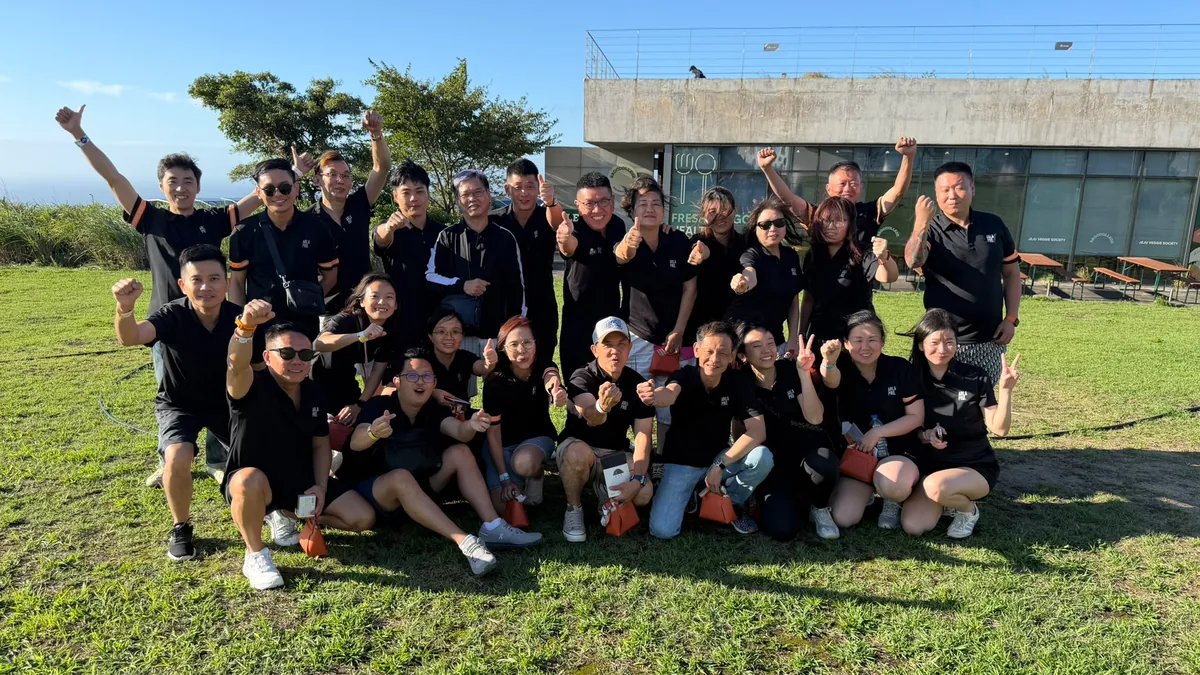
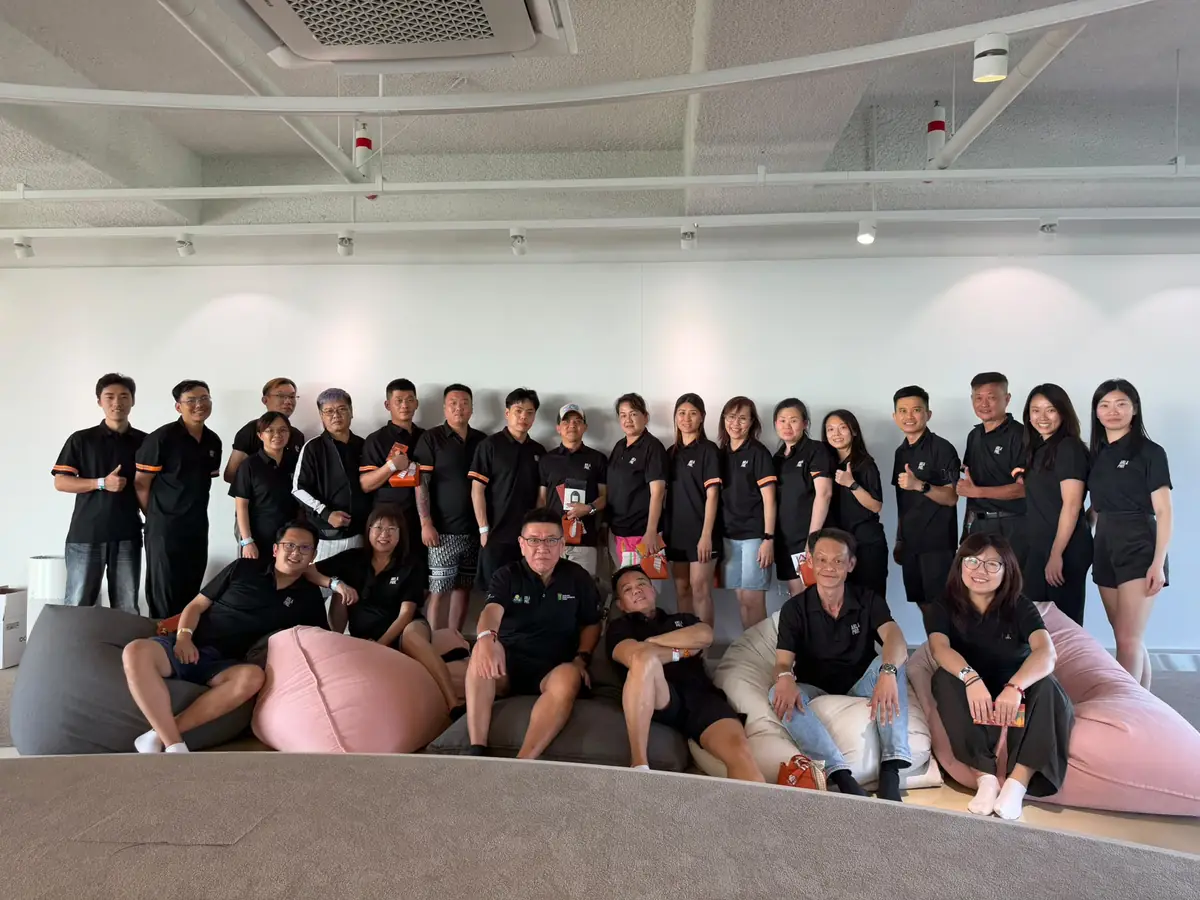
December is the busiest month this trade gets, so we close ours in September, and this year we closed it in Jeju with the company.
It has been a hard year to sell dairy in Singapore.
Here is what made it hard, what we got done anyway, and what we decided about the year ahead.
Why 2026 was difficult
Two pressures ran through the year together.
The first was on our customers.
Between 1 January and 23 October 2025, Singapore recorded 3,357 new retail food establishments and 2,431 closures.
Of those closures, 882 were businesses registered for under three years, and a further 650 had lasted between three and five.
Openings still outnumbered closures, so the sector is not shrinking, though the churn is severe.
Every closure on that list was somebody's account, and several were ours.
The second pressure came from the commodity market, which fell through most of the year.
By the last week of August, EU butter had come down to €416 per 100kg, 41 per cent below where it sat a year earlier.
Cheddar was down 28 per cent, gouda 23 per cent and edam 22 per cent. Skimmed milk powder went the other way and rose 24 per cent.
We order weeks before a container sails and pay for it long before it sells.
When the index drops in between, the cost sitting in our chiller is higher than the cost of replacing it, and our customers can read the same numbers we can.
Every quotation from the first half of the year needed reopening in the second, line by line, because the basket did not move as one thing.
What we got done
We held the cold chain, and we can produce the records for it.
Our facility in Tuas runs frozen, chilled and a dedicated milk room, everything moving through it is monitored against specification, and the paperwork exists.
It is the part of the business nobody sees, and everything else depends on it.
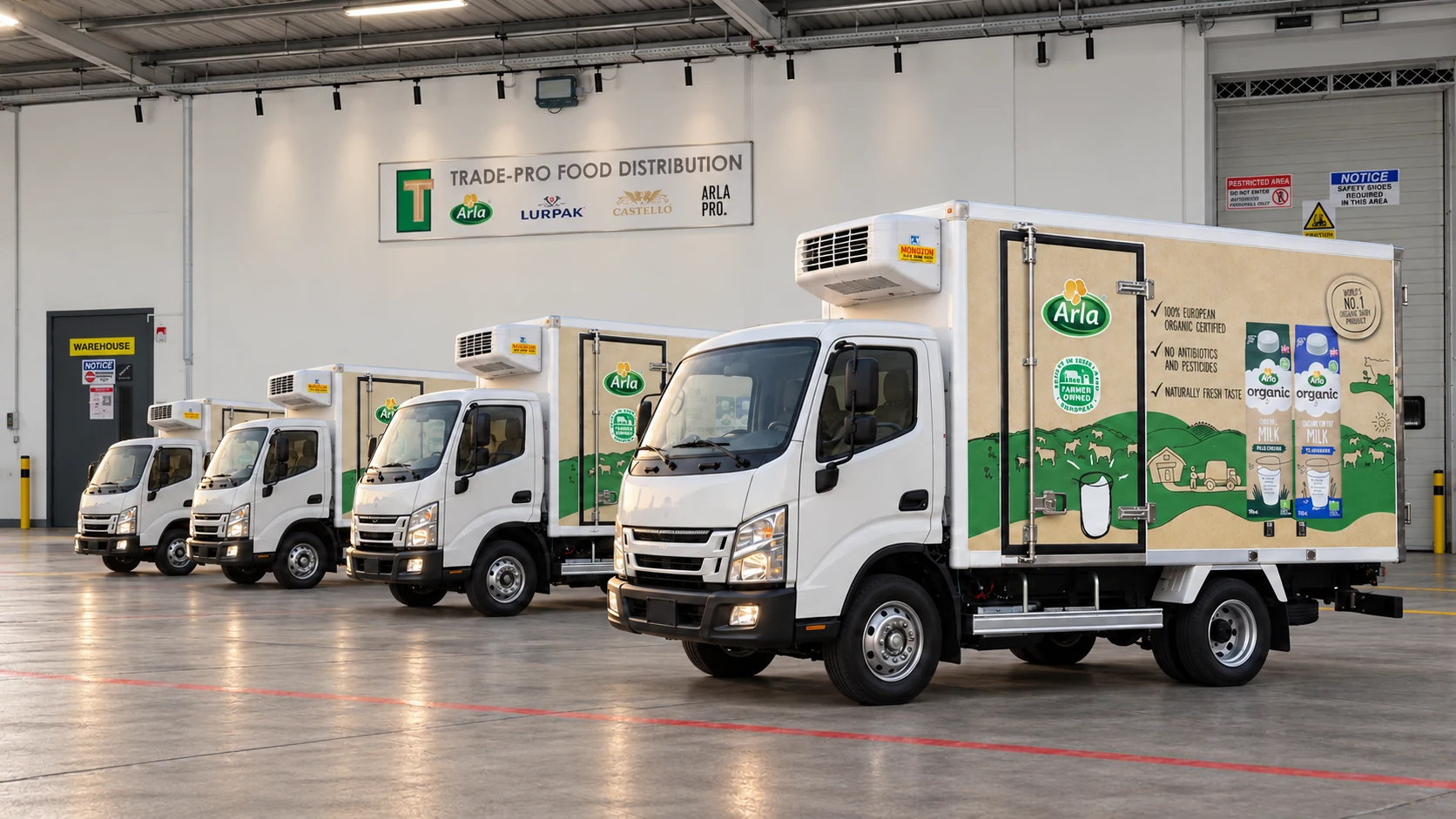
We ran a six-day delivery week for the full year, on our own refrigerated vehicles with our own drivers.
That costs more than using a third-party pool and we intend to keep paying for it, because the last hundred metres of a cold chain is where it usually breaks.
Customers have been cutting stockholding and ordering closer to need, so taking an order today and delivering it tomorrow is often the reason we get it.
We widened what a customer can take in a single delivery across chilled, frozen and ambient, so a kitchen or a shop places one order instead of three.
And we began supplying sub-distributors from local stock, which lets another business carry our brands into channels we do not reach, without committing to a container and a cold store of their own.
That became a real part of this year, and I expect it to be a larger part of next.
The retreat
Elise Koh and Shiew Teng organised Jeju, and they organised it as a genuine break, with no sessions and nothing anyone had to take notes in.
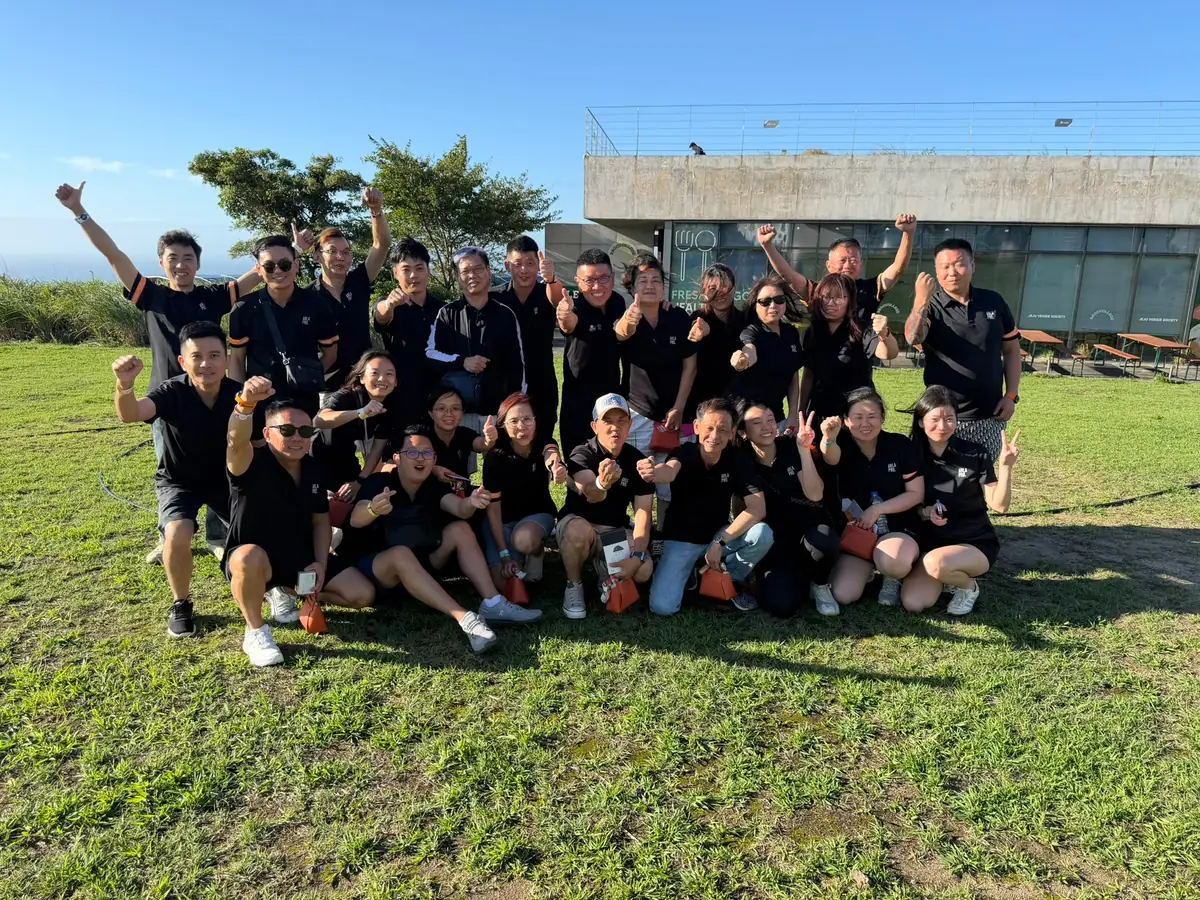
Jeju, September 2026. Most of the company in one photograph, which happens once a year.
A year like this one makes you good at reacting.
A price moves, an account closes, a permit query holds a chilled container at the port, and you deal with it.
Twelve months of that and the company is being run week by week, with nobody standing far enough back to see the shape of it.
The retreat was the first time all year we stopped.
Watching people who normally only speak to each other by phone lose badly to one another on a go-kart track, I found myself looking at the company as a whole again.
The three priorities below came out of that week.
What we are focused on in 2027
Ecommerce and grocery
Household dairy buying kept moving online while restaurants closed.
We already supply that channel and we have not given it enough attention. Next year we will.
Supplying sub-distributors
The margin gap between buying local stock and importing your own container is roughly the price of not carrying the risk.
For plenty of capable distributors, paying it is the right decision.
What we owe them is specifications up front, product training, and staying off their accounts.
Selling on evidence
Most distributors in Singapore will tell you their cold chain is sound.
Fewer can produce temperature records, a calibration schedule and an audit trail without a week's notice.
Ours are ready, and next year we intend to lead with them.
Thank you
The people behind every delivery.
Thank you to everyone who came to Jeju, and to everyone who covered a shift so somebody else could go.
Elise and Shiew Teng did the work so the rest of us never had to think about it.
And thank you to the producers and customers who spent a difficult year with us instead of shopping around.
We are planning next year on the assumption that you will still be there.
Talk to us about supply
Trade-Pro Food Distribution is a Singapore importer and distributor of premium European dairy, supplying retail, foodservice, ecommerce and sub-distributors from a purpose-built cold chain in Tuas.
Retail food establishment figures are from a written parliamentary reply by the Minister for Trade and Industry, 5 November 2025, covering 1 January to 23 October 2025. Dairy commodity prices are EU averages from the European Commission's Milk Market Observatory, week ending 30 August 2026.
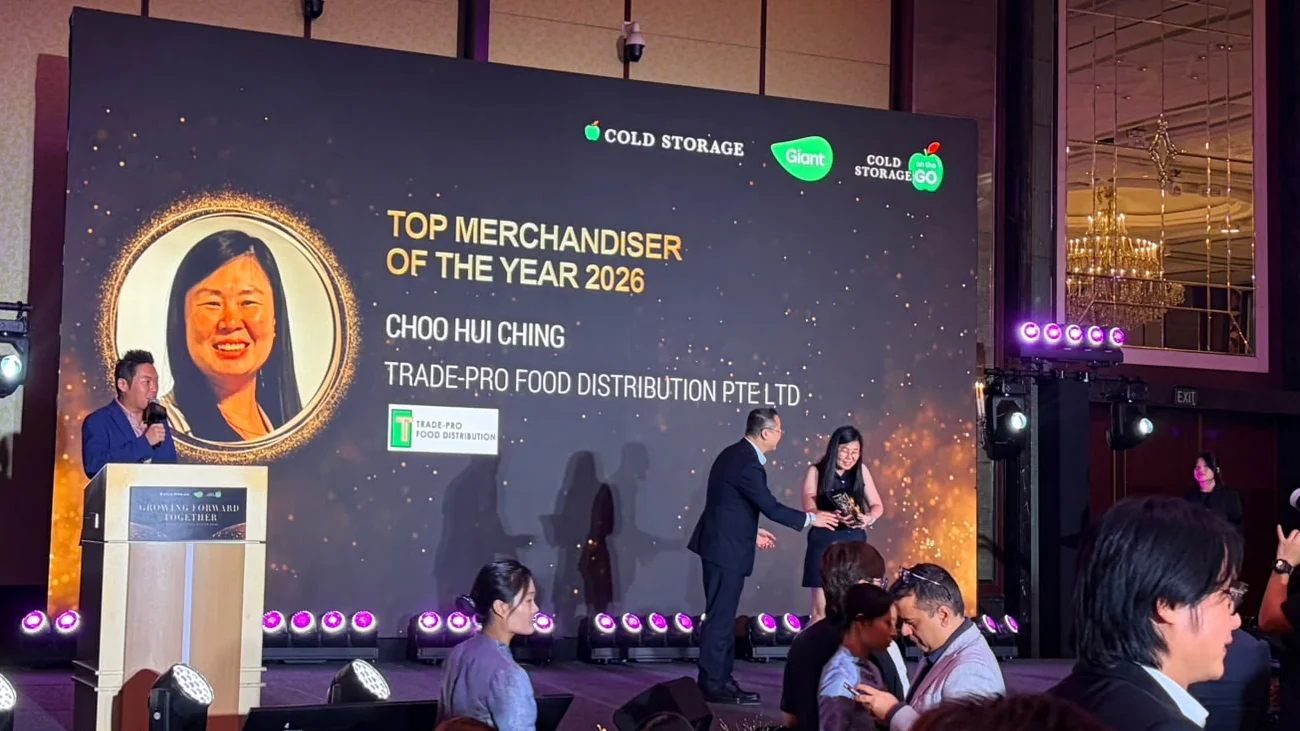
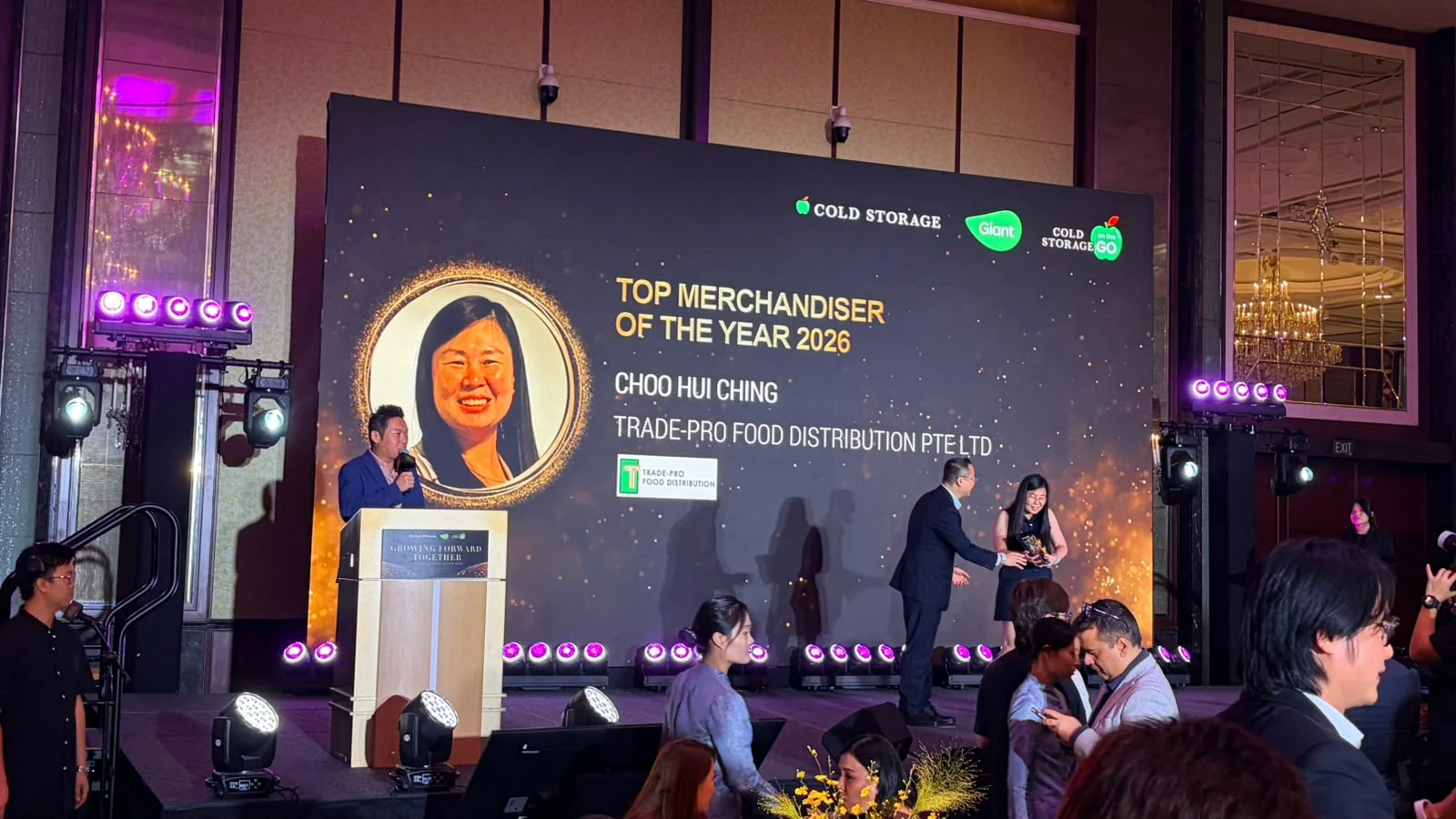
Choo Hui Ching received the award at the Cold Storage Partners Awards Dinner 2026, held under the theme Growing Forward Together.
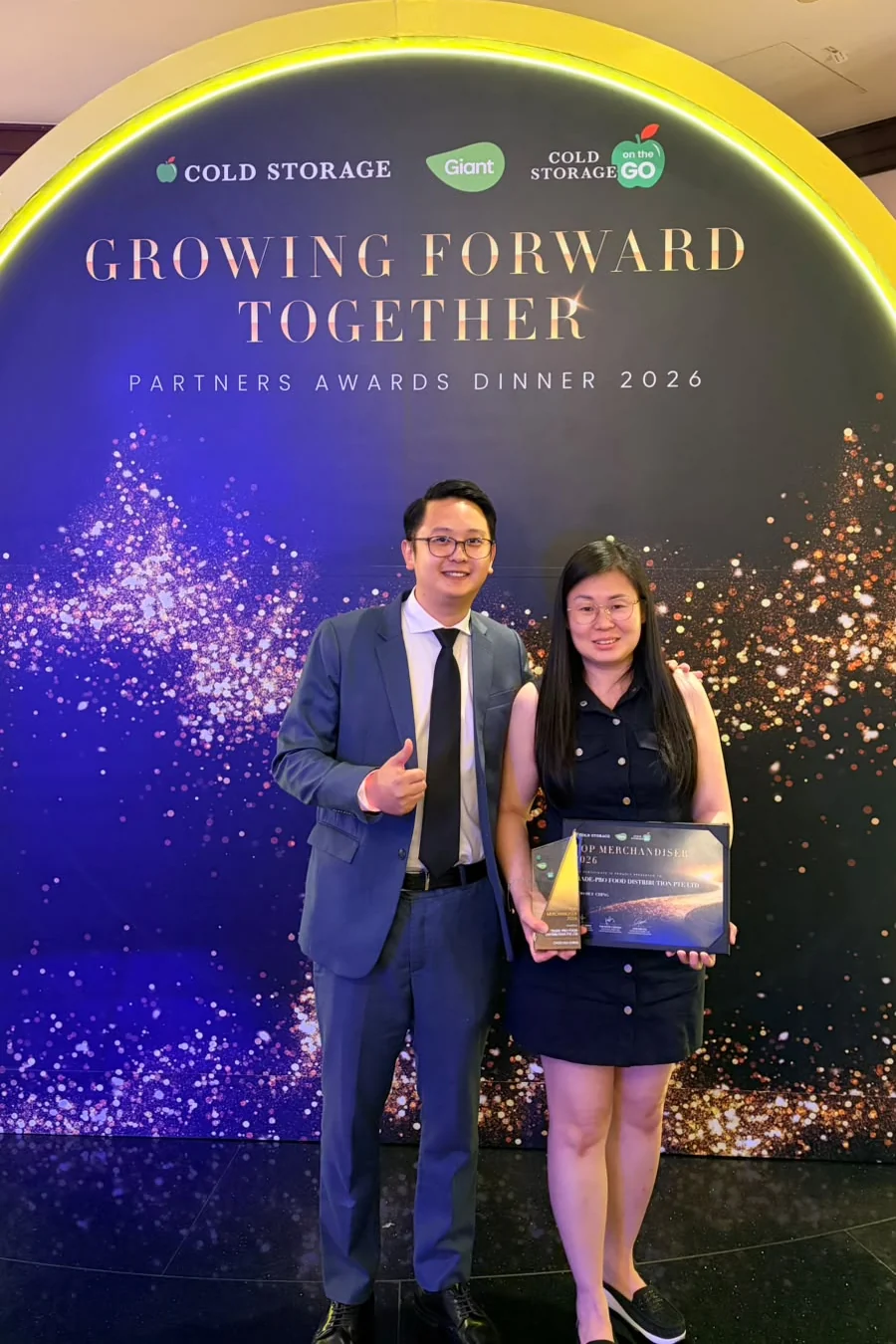
Trade-Pro Food Distribution merchandiser Choo Hui Ching was named Top Merchandiser of the Year 2026 at the Cold Storage Partners Awards Dinner on 11 September.
Cold Storage held the dinner under the theme Growing Forward Together and gave the evening to its suppliers, vendors and business partners rather than to its own business.
Part of what the retailer marked was its record with small local labels, several of which it has carried from a first listing to shelves across the group.
Ms Choo works the Cold Storage account for Trade-Pro, the official main distributor of Arla products in Singapore.
Ms Choo with the trophy, with Trade-Pro head of retail James Lin.
"I was really happy. Most of my work happens in the stores, so it meant a lot that someone noticed. The staff there know me and I know them, and if something is wrong on the shelf they call me first."
"This one belongs to the whole team though. The order, the warehouse, the drivers, all of it reaches the shelf before I do."
Choo Hui Ching, Merchandiser, Trade-Pro Food Distribution
What a merchandiser does
Merchandising is the part of the supply chain that happens after a delivery has been signed for.
Ms Choo is in stores checking that stock has been rotated, that date codes are in order and that ranges are sitting where the planogram says they should.
Displays get taken apart by shoppers over a weekend and need rebuilding.
Lines that sell faster than the replenishment cycle assumed leave gaps on shelf that nobody sees from an office.
Ms Choo reports those back, along with which products are moving and which are sitting, and that usually reaches Trade-Pro before the sales figures do.
Dairy makes the job less forgiving than most of the store.
Shelf life is short next to ambient grocery, the case runs to a temperature specification, and a pack that has sat behind newer stock for a week has lost a week the customer paid for.
None of that appears in a delivery record, and Trade-Pro treats it as the last stage of the cold chain it runs out of Tuas.
"Hui Ching is the person I want in front of our products, and it is good to see the retailer say the same."
James Lin, Senior Manager and Head of Retail, Trade-Pro Food Distribution
A retailer under new ownership
The 2026 dinner fell in the first full year of Cold Storage's new ownership.
DFI Retail Group announced in March 2025 that it was selling the Cold Storage and Giant businesses in Singapore to the Malaysian retail group Macrovalue for S$125 million, with completion expected in the second half of that year.
At the time of the announcement the business comprised 48 Cold Storage outlets, trading as CS Fresh, CS Gold and Jason's Deli, along with 41 Giant stores and two distribution centres.
Lim Boon Cheong, who had run DFI's food business in Singapore, stayed on as managing director of Cold Storage.
A change of owner at a chain that size puts listings, planograms and promotional calendars back in front of every supplier, which is the ground the theme was chosen on.
What Trade-Pro supplies
Singapore imports more than 90 per cent of its food, spread across 187 countries and regions, according to the Singapore Food Agency.
Dairy is imported almost in its entirety, so a chilled shelf in a supermarket sits at the end of a chain that starts in a European creamery and runs through a container, a port clearance and a cold store in Tuas.
Trade-Pro supplies European dairy to supermarkets and convenience chains, hotel and restaurant kitchens, online grocers and other distributors buying from local stock, six days a week.
The retail range covers cheese, butter, milk, cream and cream cheese, led by Arla, Lurpak and Castello, with Arla Pro sold to kitchens rather than shoppers.
The most recent addition to the shelf is Arla Protein, a high-protein yoghurt Arla launched in Singapore on 18 September and which is stocked at Cold Storage, Giant and Cheers.
The Tuas facility runs to 26,000 sq ft across frozen, chilled and a dedicated milk room, and six temperature-controlled trucks go out from it.
Trade-Pro owns the vehicles and employs the drivers, which costs more than using a third-party pool.
The company holds FSSC 22000 certification and is audited against it each year.
Trade-Pro Food Distribution was established in 2018 and sits within Trade-Pro Group, which has been trading since 2009.
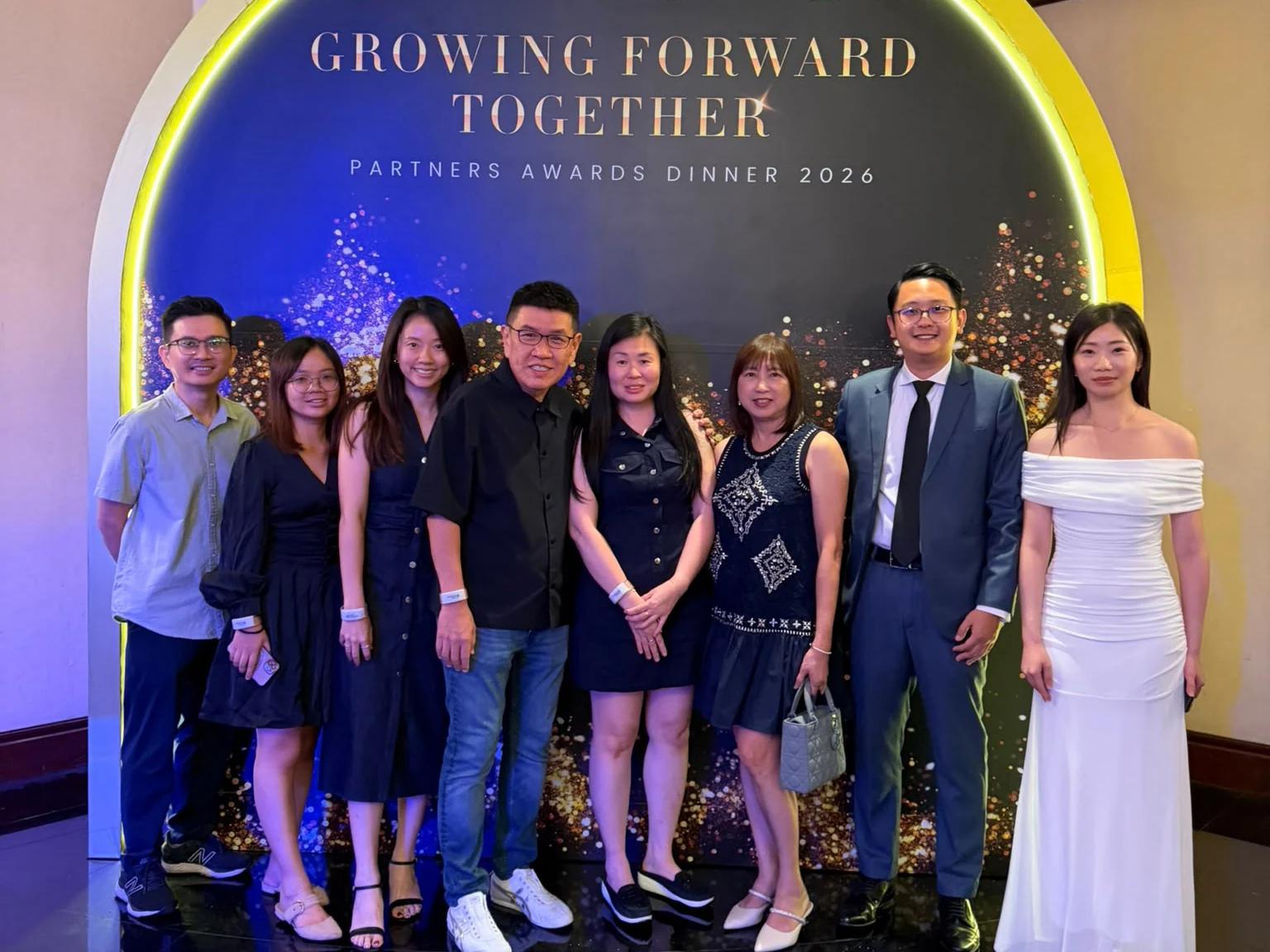
The Trade-Pro team at the Partners Awards Dinner, 11 September 2026.
Talk to us about retail supply
Trade-Pro Food Distribution supplies supermarket chains, kitchens, online grocers and other distributors across Singapore, six days a week.
A high-protein yoghurt with no added sugar, launched at The Ritz-Carlton, Millenia Singapore and on shelves now.
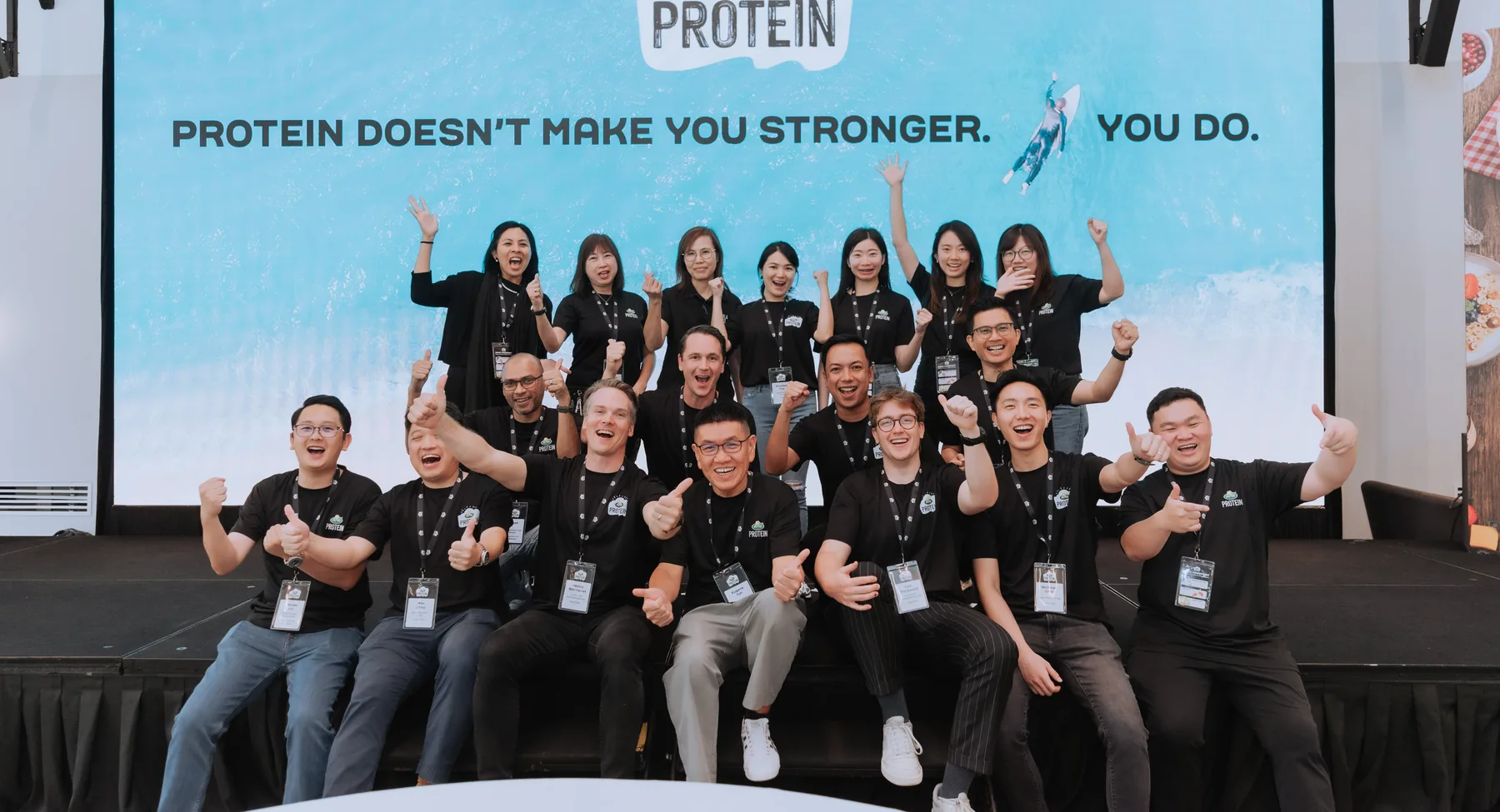
Arla Foods launched Arla Protein yoghurt in Singapore on 18 September at The Ritz-Carlton, Millenia Singapore, in front of retail partners, customers and media.
Trade-Pro Food Distribution is Arla's official main distributor in Singapore.
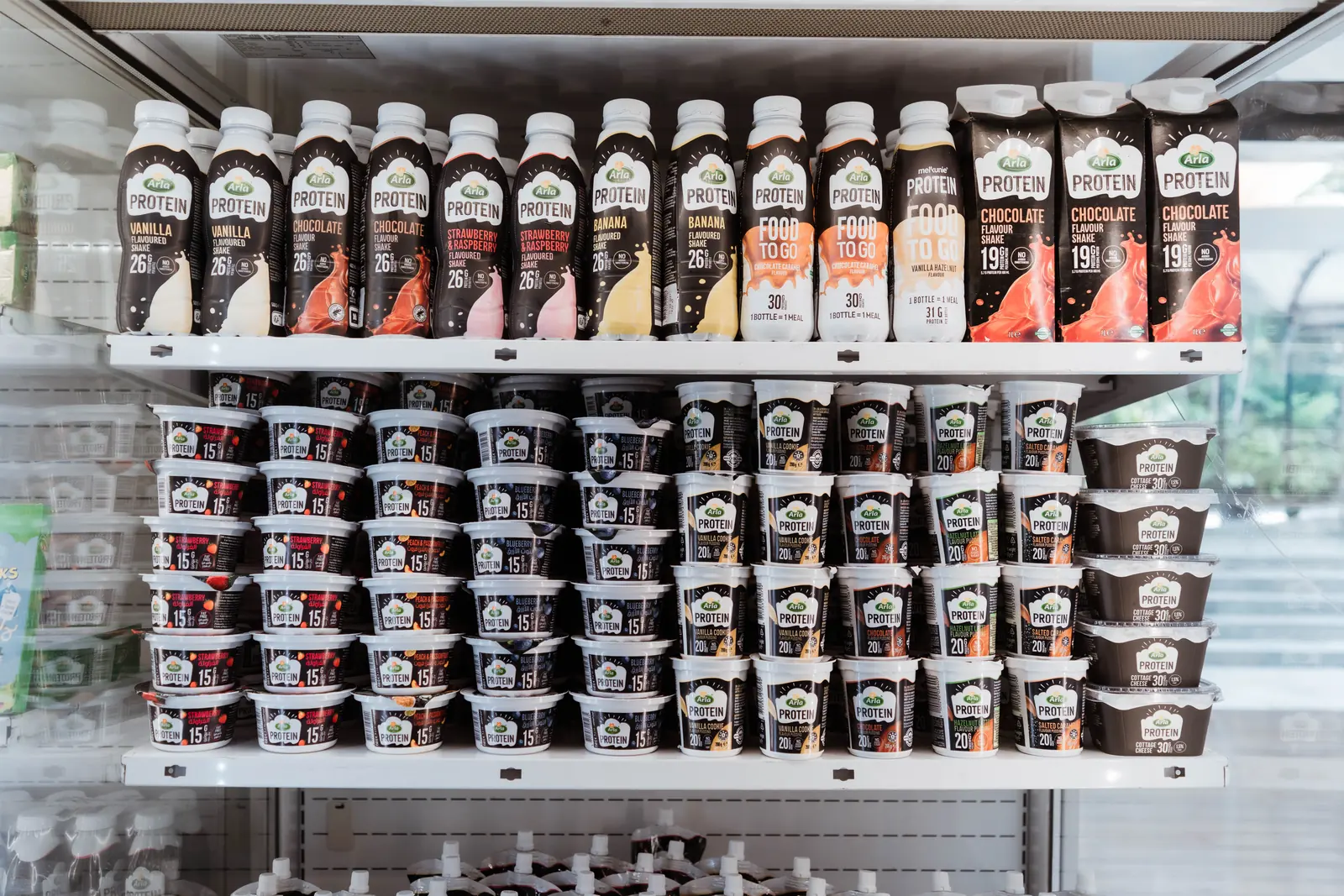
Each 150g cup carries 15g of protein. It is low fat, lactose free and has no added sugar.
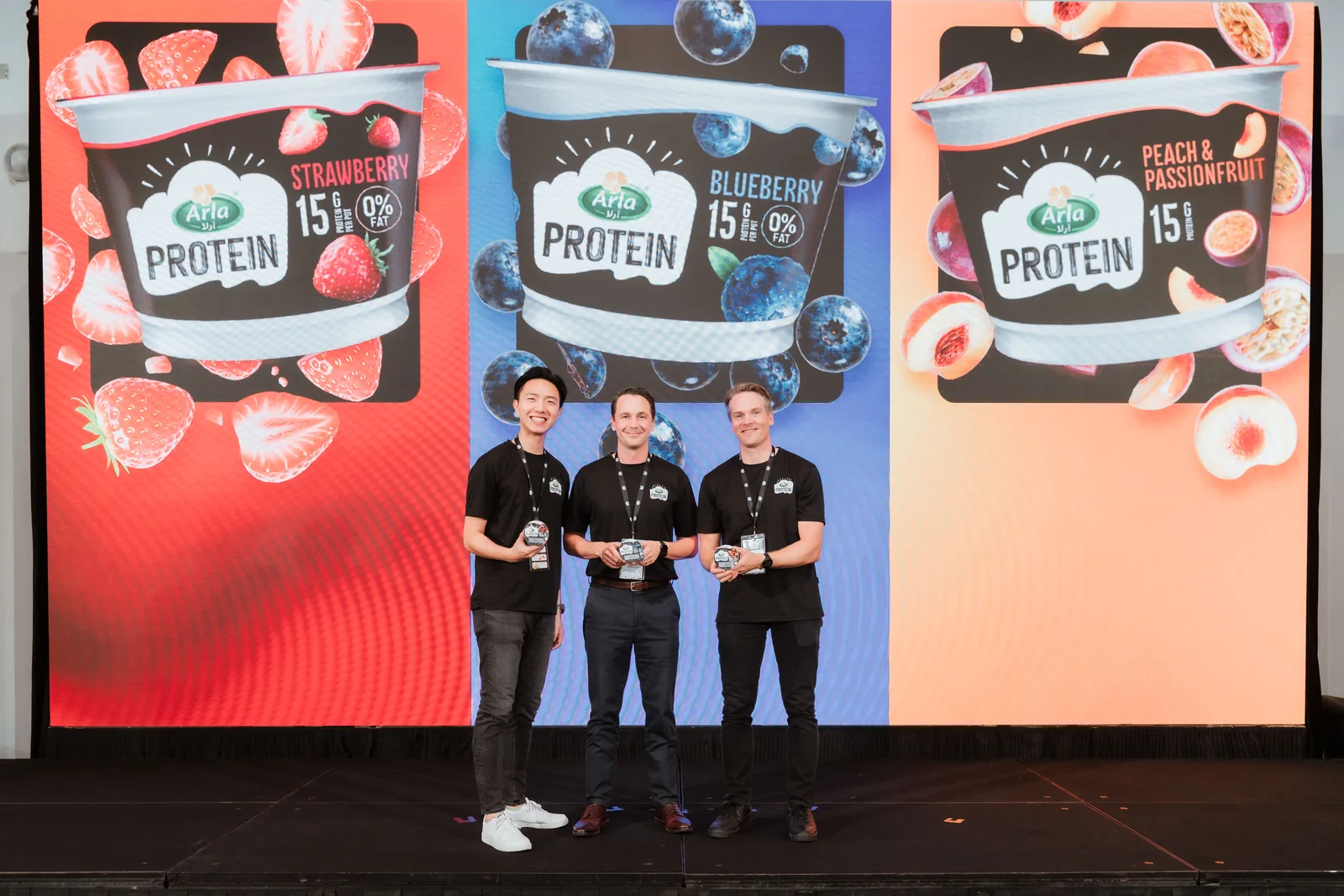
The range launches in three flavours: strawberry, blueberry, and peach and passionfruit.
Arla is positioning it for breakfast, after exercise, as an ingredient or as a snack between meetings.
Guests tried all three at the launch.
Highlights from the launch at The Ritz-Carlton, Millenia Singapore.
Protein beyond the gym
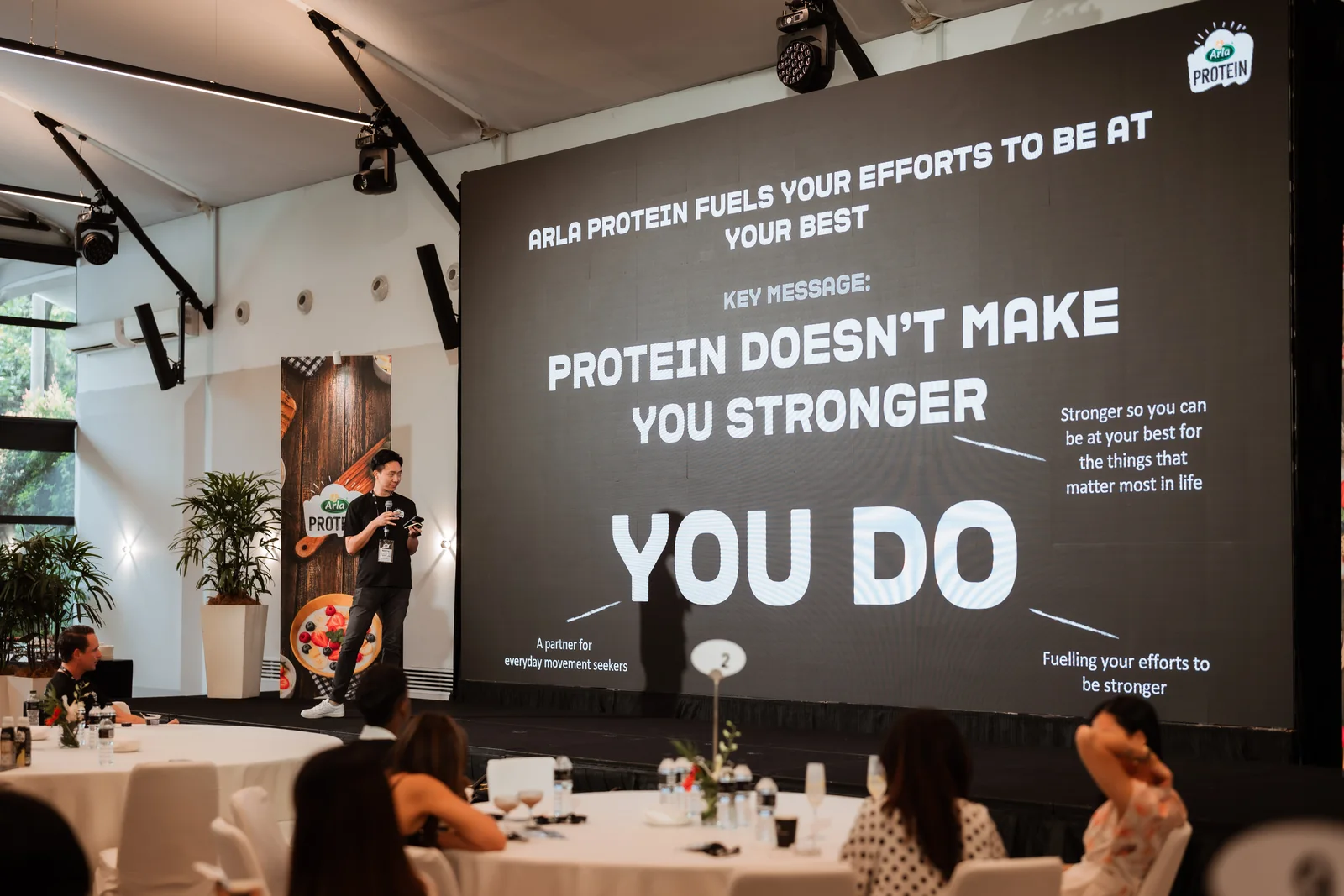
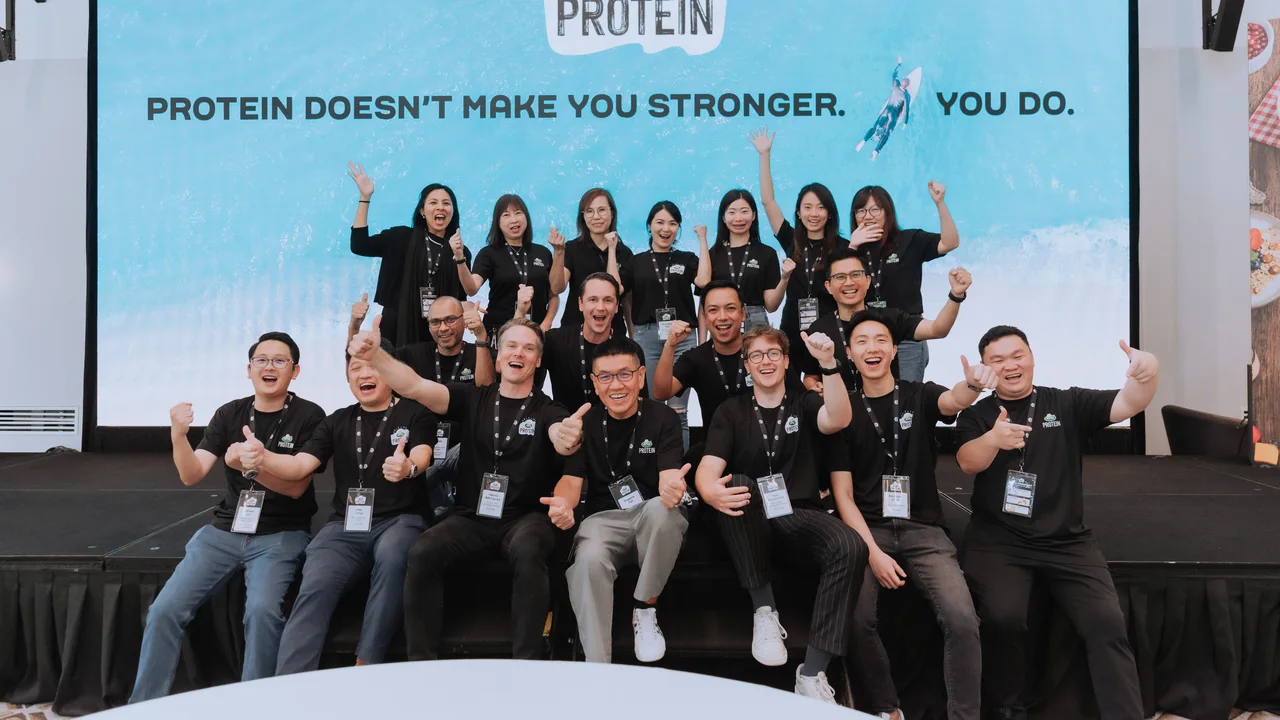
The campaign line for the launch is "Protein doesn't make you stronger. You do."
Nicholas Chan, Head of Retail for Malaysia and Singapore at Arla, took the room through it.
"Traditionally, when we talk about protein we think of gym-goers, athletes and people who are really into fitness. With Arla Protein we see a bigger, broader opportunity."
Nicholas Chan, Head of Retail, Malaysia and Singapore, Arla
Mr Chan had the walkers on Singapore's trails in mind as much as the runners chasing a personal best.
"Even if you're 10 minutes slower than your personal best, celebrate your effort, because everybody's journey is personal," he said.
The campaign line, on stage at The Ritz-Carlton, Millenia Singapore.
Taste first
Opening the event, Magnus Glennborn, Vice President for South East Asia Pacific at Arla, said adding protein on its own does not make a product people will choose.
"Just putting more protein in a product isn't good enough. You also have to make sure your healthy, nutritious products come in convenient packaging and, most importantly, taste good. That's how we enable healthier choices."
Magnus Glennborn, Vice President, South East Asia Pacific, Arla
The farms behind it
Arla is a cooperative owned by the farmers who supply its milk.
It was founded in Sweden in 1881, and after its merger with the German cooperative DMK it has more than 11,000 farmer owners across seven northern European countries.
It is the world's largest organic dairy producer.
Henrik Björkqvist, Head of Distributor Markets for South East Asia at Arla, grew up helping on his grandmother's Arla farm, and spent most of his talk on what happens there.
More than 90 per cent of dairy's carbon footprint is generated on the farm.
Arla's farmer owners have cut theirs by 23 per cent since 1990, and now produce less than half the global average for dairy. The target is net zero by 2050.
Arla was the first dairy company to work with the Science Based Targets initiative, which checks its progress independently, Mr Björkqvist said.
"These numbers don't come from us, they come from them."
Henrik Björkqvist, Head of Distributor Markets, South East Asia, Arla
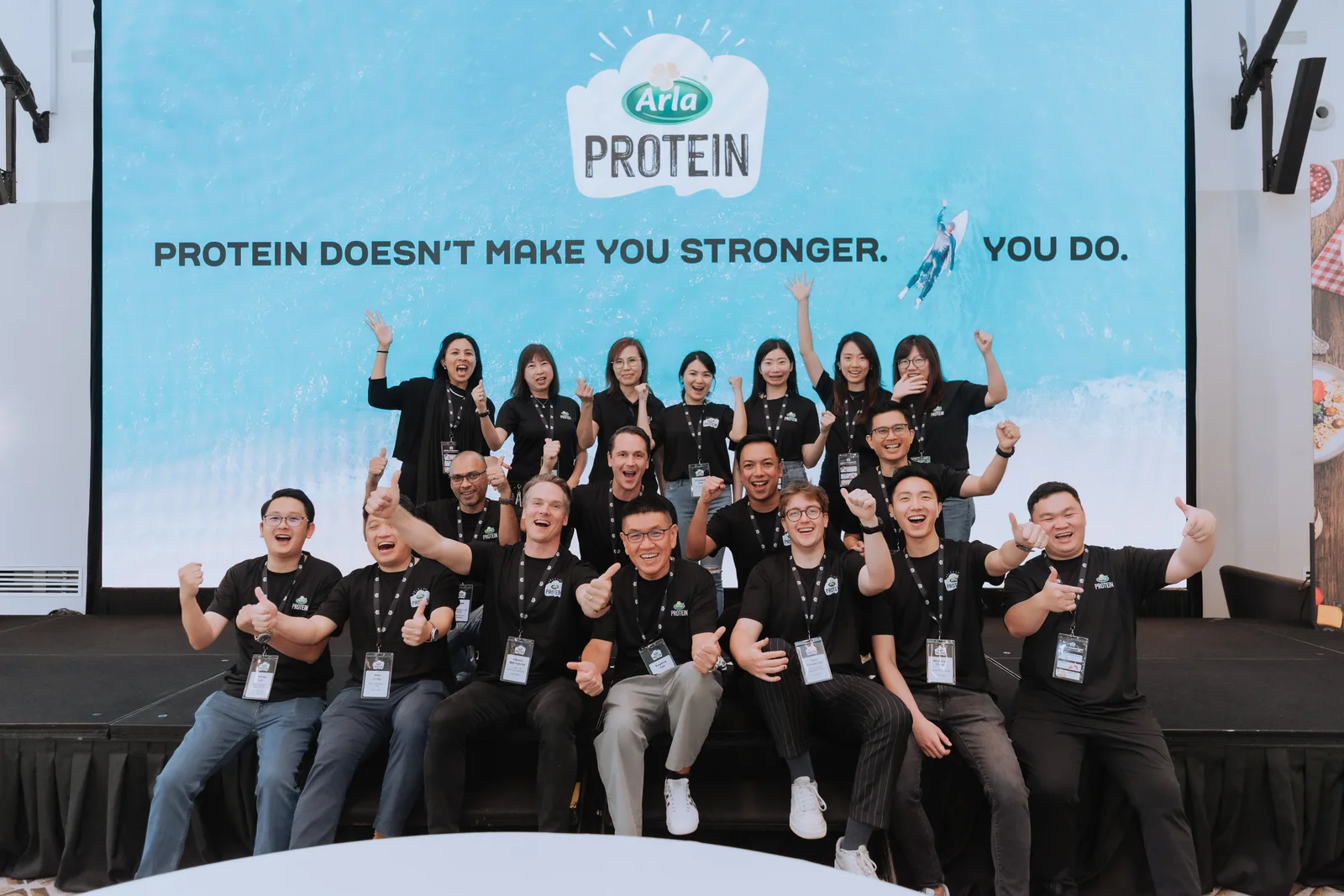
The Arla and Trade-Pro teams at the launch.
Where to buy
Arla Protein is available now at Cold Storage, Giant and Cheers, and online at RedMart, PandaMart and Shopee.
It reaches Sheng Siong from 1 October, with FairPrice and FairPrice Online to follow.
Arla Protein on display at the launch.
Stock Arla Protein
Trade-Pro Food Distribution is Arla's official main distributor in Singapore, supplying retail, foodservice, ecommerce and sub-distributors from a purpose-built cold chain in Tuas.


















 ArlaArla Foods
 AlpenhainAlpenhain Käsespezialitäten
 BeboBEBO
 Euro SelectEuro Select
 A-wareRoyal A-ware Food Group
 JERMIJERMI
 Grand'OrGrand'Or
 Mont BlancMont Blanc
 PopotePopote
 PromessPromess
 WeißenhornerWeißenhorner Milch Manufaktur